


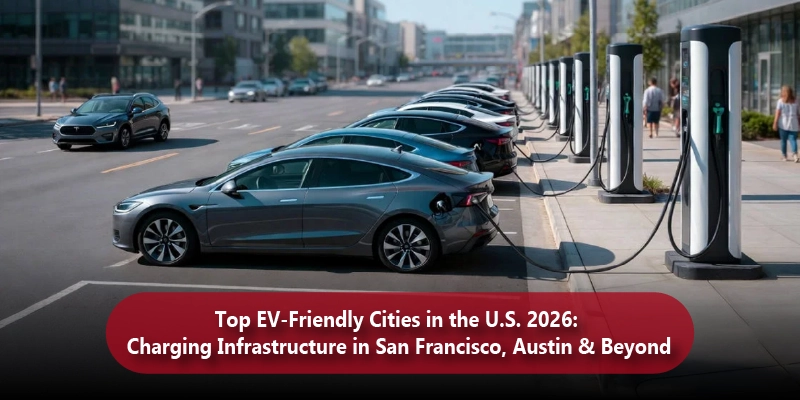
The most EV-friendly U.S. cities in 2026 include San Francisco, Austin, and Boston, offering robust charging networks, incentives, and lower EV ownership costs.
How EV Cities in the U.S. Have Evolved in 2026
The electric vehicle market in the United States will undergo a fundamental transformation by 2026. What was once an emerging technology has now become a central component of urban mobility planning. Cities are no longer reacting to EV adoption, and they are actively designing ecosystems to support it.
One of the most significant developments this year is that EV charging infrastructure growth has outpaced EV sales, marking a turning point in the industry. This shift signals a move away from early adoption challenges toward a mature, infrastructure-first model.
For American consumers, this means EV ownership is now influenced less by vehicle range and more by local infrastructure quality, charging accessibility, and energy costs. In practical terms, where you live has become just as important as the EV you drive.
Also Read: Why Hybrids Are Quietly Dominating the U.S. Auto Market in 2026
What Makes a City EV-Friendly in 2026?
Understanding the criteria behind EV-friendly cities helps explain why certain locations stand out. In 2026, a city’s EV readiness is evaluated based on several interconnected factors:
1. Charging Density and Accessibility
It’s not just about how many chargers exist, but where they are located. Cities with well-distributed charging networks across residential areas, workplaces, and highways offer a significantly better user experience.
2. Fast-Charging Infrastructure
The availability of DC fast chargers has become critical. These chargers allow drivers to replenish up to 80% of battery capacity in under 30 minutes, making EVs more practical for daily and long-distance use.
3. Affordability of Charging
Electricity rates and public charging costs vary widely across the U.S. Cities with lower per-kWh costs or subscription-based models provide a clear financial advantage.
4. Policy and Incentives
State and local incentives, including tax credits, rebates, and utility programs, play a major role in reducing the total cost of ownership.
5. Inclusivity of Infrastructure
A truly EV-friendly city ensures access for all residents including those in apartments or without private garages through curbside and shared charging solutions.
San Francisco: Still the Benchmark for Urban EV Integration
San Francisco continues to set the standard for EV infrastructure in dense urban environments. Its approach is not just about scale, but about solving real-world accessibility challenges.
One of the city’s most impactful strategies has been the expansion of curbside charging stations, particularly in neighborhoods where private parking is limited. This initiative ensures that EV ownership is not restricted to homeowners.
Another critical factor is the implementation of right-to-charge policies, which legally support tenants requesting EV charger installations in rental properties. This has significantly expanded access for apartment dwellers which is a demographic that historically faced barriers to EV adoption.
In 2026, San Francisco supports over 1,500 public charging ports, with a growing share dedicated to high-speed DC charging. Additionally, strict building codes now require new developments to include EV-ready infrastructure, ensuring long-term scalability.
However, while San Francisco excels in accessibility and policy, it faces increasing competition in terms of total fast-charger deployment.
Austin, Texas: The Fastest-Growing EV Ecosystem in the U.S.
Austin represents one of the most compelling success stories in EV infrastructure development. Unlike legacy EV hubs, Austin’s growth has been both rapid and strategically targeted.
A key driver behind this expansion is a $15 million federal Charging and Fueling Infrastructure grant, which enabled the city to address underserved areas rather than focusing solely on high-density urban centers.
By 2026, Austin will have deployed over 1,800 public charging stations, with extensive coverage along major commuting routes, including Interstates. This ensures that both urban and suburban residents have reliable access to charging.
Austin’s integration with the Plug-In Everywhere initiative further enhances its appeal. This program provides:
- Affordable subscription-based charging plans
- Incentives for home charger installations
- Expanded infrastructure in multifamily housing complexes
Importantly, Austin has aligned its EV strategy with broader climate and equity goals, ensuring that infrastructure development benefits all communities. This inclusive approach is a major reason why Austin is now considered one of the top EV-friendly cities in the U.S.
Boston, Massachusetts: Leading in Affordability and Incentives
Boston stands out as one of the most cost-effective cities for EV ownership in 2026. While it may not lead to total charger volume, it excels in reducing the financial barriers associated with EV adoption.
Massachusetts offers some of the most generous EV incentives in the country, with rebates ranging from $3,500 to $6,000. These incentives significantly lower the upfront cost of purchasing an electric vehicle.
In addition to financial support, Boston has invested heavily in expanding its charging infrastructure, now exceeding 1,800 public chargers. The city’s compact layout also works in its favor, as shorter travel distances reduce the need for frequent charging.
For cost-conscious consumers, Boston offers a balanced combination of infrastructure and affordability, making it one of the most practical EV cities in the U.S.
Kansas City, Missouri: The Hidden Leader in Low-Cost Charging
Kansas City has emerged as a sleeper EV hub, particularly for drivers focused on minimizing operational costs.
The city offers some of the lowest public charging rates in the United States, making it an attractive option for budget-conscious EV owners. This cost advantage is complemented by a steadily growing charging network that supports both urban and suburban areas.
While Kansas City may not yet match the infrastructure scale of coastal cities, its affordability gives it a unique competitive edge especially as EV adoption continues to expand into the Midwest.
Denver, Colorado: Rapid Growth and High EV Adoption
Denver’s rise as an EV-friendly city is closely tied to its strong environmental policies and growing consumer demand for sustainable transportation.
The city has seen a 60% increase in charging infrastructure and a significant rise in EV registrations per capita. This indicates not only strong infrastructure development but also widespread consumer acceptance.
Denver’s geographic location also makes it a critical hub for long-distance EV travel, with charging corridors connecting major western states.
Top EV-Friendly Cities in 2026
| City | Public Chargers | Key Strength | Affordability | EV Adoption Growth |
| San Francisco | 1,500+ | Urban accessibility & policy | Moderate | High |
| Austin | 1,800+ | Fastest infrastructure growth | High | Very High |
| Boston | 1,800+ | Strong rebates & incentives | Very High | High |
| Kansas City | 1,200+ | Lowest charging costs | Excellent | Moderate |
| Denver | 1,600+ | High adoption & expansion | Moderate | High |
Benefits of Living in an EV-Friendly City
Lower Total Cost of Ownership
Reduced fuel costs, combined with incentives and lower electricity rates, make EV ownership significantly more affordable in top cities.
Increased Property Value
Homes equipped with EV chargers are seeing measurable increases in market value, reflecting growing demand.
Enhanced Convenience
Dense charging networks eliminate the need for extensive route planning, making EVs as convenient as traditional vehicles.
Environmental Impact
Cities with strong EV infrastructure contribute to lower emissions and improved air quality, aligning with broader sustainability goals.
Common Mistakes EV Owners Should Avoid
Even in well-developed EV cities, certain mistakes can reduce efficiency and increase costs.
Ignoring Idle Fees
Many charging networks now impose fees if a vehicle remains plugged in after reaching full charge.
Over-Reliance on Slow Charging
Depending solely on Level 2 chargers can lead to unnecessary delays, particularly in busy urban areas.
Not Using Charging Apps
Access to many charging stations requires dedicated apps, making it essential to stay connected to multiple networks.
Also Read: Big Auto Changes in 2026: VW ID.4 Ends, BMW iX Axed & New Models Revealed
Frequently Asked Questions
Which U.S. cities are best for EV ownership in 2026?
San Francisco, Austin, and Boston lead due to strong infrastructure, incentives, and accessibility.
What is the cheapest city for EV charging?
Kansas City offers some of the lowest public charging rates in the country.
Is EV ownership practical in apartments?
Yes, most top cities now support curbside and shared charging solutions.
Why is Austin growing rapidly in EV infrastructure?
Federal funding and targeted expansion into underserved areas have accelerated growth.
What defines an EV-friendly city today?
Charger accessibility, fast-charging availability, affordability, and supportive policies.
Key Takeaways
- EV infrastructure in the U.S. is now growing faster than vehicle adoption, signaling a shift toward infrastructure readiness.
- California remains a leader, but Texas and Midwest cities are rapidly closing the gap.
- Austin is the fastest-growing EV city in 2026, driven by federal funding and inclusive planning.
- Boston and Kansas City stand out for affordability, offering lower ownership and charging costs.
- Charging speed and accessibility now matter more than total charger count.
- DC fast-charging networks are becoming the backbone of urban and highway EV mobility.
- Apartment-friendly solutions like curbside and shared charging are expanding EV access in dense cities.
- State and local incentives continue to play a critical role in accelerating EV adoption.
- Smart charging networks and app-based integrations are improving user experience and efficiency.
- Workplace and commercial charging infrastructure are growing, supporting daily commuting needs.
- EV-friendly cities are increasingly integrating renewable energy into their charging ecosystems.
- Real estate trends show rising demand and value for homes equipped with EV charging solutions.
Get More Updated Automotive Insights at Ask about cars!
For More Car-Related Blogs: Most Reliable SUVs for 2026: Top Picks that hold their value and skip the Repair Bills
