


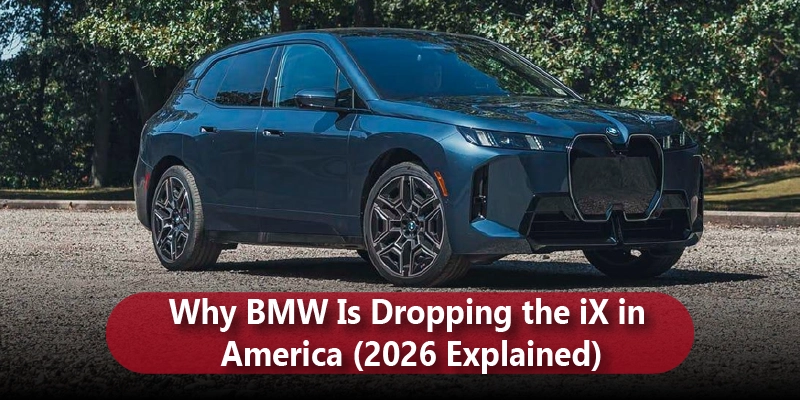
The 2026 auto shift replaces early EVs like the Volkswagen ID.4 and BMW iX with advanced, affordable, long-range models built on next-gen platforms.
The Turning Point: Why 2026 Is a Defining Year for the Auto Industry
The global automotive industry is undergoing one of its most decisive transformations in decades. The year 2026 is not just another model, and it marks the transition from experimental electric vehicles to highly optimized, scalable, and consumer-focused mobility solutions.
Legacy automakers that once rushed to introduce electric vehicles are now recalibrating their strategies. Models that symbolized the first wave of electrification are being phased out, replaced by vehicles built on more advanced architectures with improved efficiency, charging speed, and real-world usability.
This shift is not a failure of EVs, and it is a maturation phase. The industry is moving beyond proof of concept vehicles toward products that meet mass-market expectations in pricing, performance, and practicality.
Why the Volkswagen ID.4 Is Being Discontinued in 2026
Volkswagen ID.4 was one of the earliest mainstream electric SUVs designed to compete globally. However, its discontinuation in 2026 reflects strategic realignment rather than a collapse in demand.
Volkswagen is restructuring its production priorities, particularly at its Chattanooga plant in the United States. The focus is shifting toward vehicles that deliver stronger margins and higher demand consistency.
A key factor is the resurgence of internal combustion SUVs like the Volkswagen Atlas, which continue to dominate sales charts in North America. While EV adoption is growing, it has not yet reached the scale needed to justify large-volume production of first-generation platforms like the ID.4.
Additionally, evolving battery regulations and sourcing requirements have made it more difficult for certain EVs to qualify for incentives, affecting their competitiveness in price-sensitive markets.
From a product standpoint, the ID.4 also faces limitations. Its charging speed, software ecosystem, and range efficiency no longer match what newer EV architectures can deliver. Rather than investing heavily in incremental upgrades, Volkswagen is preparing to introduce a completely new generation of electric vehicles, likely under more familiar naming conventions, such as an electric version of the Tiguan.
Also Read: Top SUVs for Families in Los Angeles: Comfort, Space & Fuel Efficiency Compared
BMW iX Exit in the U.S: A Strategic Upgrade
BMW iX was never designed as a mass-market product. It served as a technological flagship, a platform to test design, software, and electrification concepts.
In 2026, BMW is retiring the iX from the U.S. market to make room for its next-generation EV lineup built on the Neue Klasse architecture.
BMW iX3 and future models will feature:
- 800-volt electrical systems
- Faster charging capabilities
- Higher energy density batteries
- Improved range
The shift reflects a broader industry trend moving away from experimental EVs toward fully integrated product ecosystems.
For consumers, this means better vehicles but also a temporary phase where older EVs may see faster depreciation as new technologies enter the market.
Key Auto Industry Changes in 2026
The changes in 2026 extend far beyond individual models. They represent a systemic evolution in how vehicles are engineered, manufactured, and sold.
1. Transition to 800V Architecture
Most new EVs launching in 2026 will adopt 800V systems, significantly reducing charging times. Vehicles can now charge from 10% to 80% in under 20 minutes, making EV ownership more practical for long-distance travel.
2. Charging Standardization (NACS Adoption)
Automakers are aligning with Tesla’s charging ecosystem, creating a more unified and accessible infrastructure. This eliminates compatibility concerns and improves long-term usability.
3. Shift Toward Profitability
Early EV strategies prioritized market entry. In 2026, automakers are prioritizing profitability, focusing on models that deliver both volume and margin.
4. Rise of Software-Defined Vehicles
Vehicles are increasingly controlled by software rather than hardware. Features, performance upgrades, and even driving capabilities can be updated over time.
5. Hybrid Comeback
Interestingly, hybrids are making a strong return. Plug-in hybrids with extended electric range are becoming a practical alternative for buyers hesitant to go fully electric.
New Car Models Leading the 2026 Market
While some vehicles are being discontinued, a new generation of EVs is entering the market with significantly improved capabilities.
Notable upcoming models include:
- Rivian R2 – Positioned as an affordable adventure EV
- Kia EV2 – Targeting budget-conscious urban buyers
- Cadillac Vistiq – Expanding Cadillac’s EV lineup
- BMW iX3 – Built on Neue Klasse platform
These models are designed to meet real-world consumer expectations, not just regulatory requirements.
Old EVs vs New-Gen EVs in 2026
| Feature | First-Gen EVs (ID.4, iX) | New-Gen EVs in 2026 Models |
| Platform | Transitional | Dedicated EV architecture |
| Charging Speed | 100-150 kW | 250-350 kW (800V) |
| Range | 250-320 miles | 350-450+ miles |
| Software Updates | Limited | Full OTA ecosystem |
| Charging Port | CCS | NACS standardized |
| Pricing Strategy | Premium / Experimental | Mass-market optimized |
| Resale Value Stability | Moderate | Higher future-proof |
What This Means for Buyers in 2026
The 2026 market demands more strategic decision-making from buyers.
Purchasing a first-generation EV at this stage may seem attractive due to discounts, but it carries long-term trade-offs. Technology cycles in EVs are currently evolving faster than in traditional vehicles, which means depreciation can be sharper.
On the other hand, waiting for next-generation models offers clear advantages:
- Faster charging
- Longer range
- Better software integration
- Stronger resale value
Buyers should also evaluate their usage patterns. For many, hybrid vehicles may offer the best balance between efficiency and convenience during this transition phase.
Also Read: Best Used Cars Under $15,000 in the U.S. That Still Feel Brand New (2026 Guide)
Common Mistakes to Avoid
Many buyers make avoidable errors during major market transitions like the one we are seeing in 2026. As the industry rapidly evolves, decisions that seem cost-effective in the short term can lead to long-term compromises in usability, resale value, and overall ownership experience.
One of the most common mistakes is focusing purely on upfront pricing while ignoring the underlying technology stack. A lower-priced EV especially from the first generation, may appear to offer strong value, but it often comes with limitations in battery efficiency, charging speed, and software capabilities. Vehicles like the Volkswagen ID.4, while still practical, may not match the performance benchmarks of newer models built on advanced platforms. As a result, buyers could face quicker depreciation and reduced long-term satisfaction.
Another critical oversight is charging compatibility. With the industry moving rapidly toward the North American Charging Standard, vehicles that depend on CCS ports and external adapters may introduce friction in daily use. While adapters solve the problem temporarily, they are not always seamless or future-proof. Over time, this could impact convenience, especially as charging infrastructure becomes more standardized and optimized for native NACS support.
Equally important, but often underestimated, is the role of software. Modern vehicles are no longer just mechanical machines; they are software-driven ecosystems. From battery management and range optimization to infotainment and driver assistance systems, software defines the ownership experience. Models such as the BMW iX demonstrated early innovation in this area, but newer vehicles are taking it further with full over-the-air updates, continuous feature enhancements, and improved system stability. Ignoring this aspect can mean missing out on performance improvements and new functionalities over time.
Ultimately, buyers who fail to evaluate these factors holistically risk investing in vehicles that may feel outdated much sooner than expected. In a fast-moving market like 2026, it is not just about what a car offers today, but how well it will adapt to the future.
Most Common Questions
Why was the VW ID.4 discontinued in 2026?
Volkswagen is reallocating production to higher-demand SUVs and preparing next-gen EV platforms.
Is the BMW iX permanently discontinued in the U.S.?
Yes, it’s being phased out to make way for Neue Klasse-based EVs.
What replaces the BMW iX?
Next-gen models like the BMW iX3 will take their place.
What is the biggest auto industry change in 2026?
The shift to 800V EV architecture and standardized charging systems.
Are EVs becoming cheaper in 2026?
Yes, new models are targeting affordable mass-market price ranges.
Should I buy an EV in 2026 or wait?
Waiting for late-2026 models offers better technology and value.
Key Takeaways
- Volkswagen ID.4 and BMW iX signal the end of first-generation EV experimentation.
- Automakers are shifting focus from early adopter EVs to scalable, high-demand models.
- 800V architecture is becoming the new benchmark for fast charging and efficiency.
- NACS Tesla-style charging ports are rapidly becoming the global standard.
- Next-gen EVs will offer 400+ miles of range and sub-20-minute fast charging.
- Affordability is improving, with more EVs entering the $35K-$45K segment.
- Software-defined vehicles will dominate, enabling OTA updates and feature upgrades.
- Resale values of older EVs may decline faster due to rapid tech advancements.
- Hybrid vehicles are making a strong comeback as a practical transition option.
- Production strategies are shifting toward profitability rather than aggressive EV expansion.
- Buyers should avoid investing in end-of-life EV platforms in 2026.
- Waiting for late-2026 launches can deliver significantly better long-term value.
- Charging infrastructure improvements will reduce range anxiety significantly.
- Brand strategies are moving toward fewer but more competitive EV models.
- The EV market is entering a maturity phase focused on real-world usability, not just innovation.
Get More Automotive Insights at Ask About Cars!
For More Car-Related Blogs:
Used Car Prices Are Rising Again in 2026 — Here’s What’s Driving the Surge