


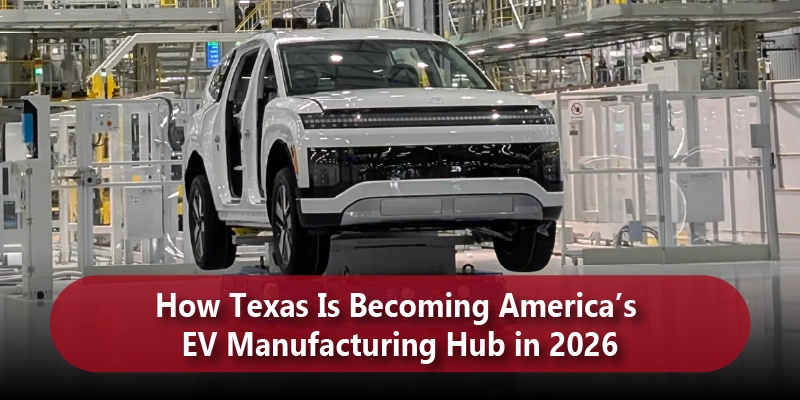
Texas leads the US EV industry in 2026 through large-scale production, battery innovation, and advanced automation ecosystems.
The United States electric vehicle industry is undergoing a structural transformation, and by 2026, Texas will have emerged as its most influential manufacturing hub. Historically dominated by legacy automotive regions like Michigan and innovation centers like California, the EV landscape has shifted toward states capable of supporting large-scale, vertically integrated production.
Texas stands out because it has not simply adapted to the EV transition, and it has engineered an entirely new industrial model. From vehicle assembly and semiconductor production to battery manufacturing and energy storage, the state has built a detailed ecosystem that supports every stage of the EV lifecycle.
With more than 477,000 registered EVs, rapidly expanding infrastructure, and multi-billion-dollar investments, Texas is now setting the benchmark for how modern automotive hubs operate in the United States.
The Strategic Shift: From Oil Capital to EV Powerhouse
Texas’s emergence as a leading EV manufacturing hub is especially significant when viewed against its long-standing identity as the center of the U.S. oil and gas industry. Instead of moving away from this legacy, the state has strategically built upon it. The same expertise that once powered fossil fuel extraction, large-scale energy infrastructure, logistics networks, and industrial engineering has been redirected to support electrification. Refineries, pipelines, and energy distribution systems have evolved alongside new investments in battery production, renewable energy integration, and grid-scale storage.
What sets Texas apart is its ability to repurpose its energy dominance into a multi-dimensional advantage. The state’s robust power grid, access to natural resources, and experience in managing high-demand energy systems have made it uniquely capable of supporting energy-intensive EV manufacturing. At the same time, Texas has expanded into wind and solar energy, creating a diversified energy mix that aligns with the needs of electric mobility.
Also Read: 7 Reasons Americans Are Avoiding Electric Cars in 2026
Key Drivers Behind the Transformation
1. Industrial Scalability
Texas offers vast land availability, making it ideal for building large-scale manufacturing plants, battery facilities, and logistics hubs.
2. Pro-Business Regulatory Environment
Favorable tax policies and streamlined permitting processes have accelerated industrial development.
3. Energy Infrastructure Advantage
Texas operates one of the largest independent power grids in the US, enabling it to support energy-intensive EV manufacturing operations.
4. Workforce Expansion
The growth of high-tech manufacturing has attracted skilled labor across engineering, robotics, and AI-driven production systems.
Gigafactory Texas: The Core of EV Manufacturing Innovation
At the center of this ecosystem is Tesla’s Gigafactory in Austin, which represents one of the most advanced automotive manufacturing facilities in the world.
By 2026, the facility has reached unprecedented levels of efficiency and output, redefining how vehicles are produced at scale.
Key Capabilities
- Annual production exceeding 1.6 million vehicles
- Integration of the 4680 battery cell manufacturing
- Deployment of over 1,200 advanced humanoid and industrial robots
- Real-time AI-driven production optimization
The facility’s design reflects a fully vertically integrated model, where multiple stages of production occur within a single ecosystem. This reduces logistical complexity, minimizes delays, and improves cost efficiency.
Beyond production, the Gigafactory acts as a magnet for suppliers, attracting battery manufacturers, semiconductor companies, and logistics providers to the region.
Battery Manufacturing and Energy Storage: The Backbone of the EV Ecosystem
A defining feature of Texas’s EV leadership is its emphasis on battery technology and energy storage solutions. Unlike traditional automotive hubs that focus primarily on vehicle assembly, Texas has prioritized the entire energy lifecycle.
This means the state is investing not only in battery production, but also in raw material processing, cell manufacturing, energy storage deployment, and end-of-life battery reuse. By building capabilities across each stage, Texas reduces supply chain dependencies while improving efficiency and cost control.
Expansion of Battery Facilities
Texas is home to a growing number of battery production and processing plants, supporting both EV manufacturing and grid-level storage.
These facilities contribute to:
- Reduced dependence on imported battery components
- Faster supply chain cycles
- Lower production costs
Battery Repurposing and Circular Economy
One of the most significant innovations is the repurposing of used EV batteries.
Instead of being discarded, batteries are:
- Reused for grid stabilization
- Integrated into renewable energy storage systems
- Deployed for commercial and residential backup power
This approach creates a circular energy economy, where resources are continuously reused, reducing environmental impact while improving efficiency.
EV Adoption Trends Across Texas
The success of the manufacturing ecosystem is mirrored by strong consumer adoption across the state.
Regional Adoption Insights
Dallas-Fort Worth
DFW leads in EV registrations, accounting for a significant share of the state’s total. Its extensive urban infrastructure and rapid charging network expansion make it a key adoption center.
Houston
Houston’s integration of EV technology with its energy sector has accelerated adoption, particularly in commercial fleets.
Austin
Austin remains the innovation hub, with high EV penetration driven by a tech-savvy population and proximity to manufacturing facilities.
Infrastructure Development: Charging and Grid Integration
EV adoption at scale requires robust infrastructure, and Texas has made significant progress in this area.
Charging Network Expansion
- Rapid deployment of fast-charging stations across highways and urban centers
- Increased investment from both private and public sectors
- Integration with national charging networks
Grid Modernization
Texas’s independent grid, managed by ERCOT, has evolved to accommodate EV growth through:
- Smart load management systems
- Energy storage integration
- Vehicle-to-grid technologies
These innovations allow EVs to act as distributed energy assets, supporting grid stability rather than straining it.
Automation and Advanced Manufacturing
Automation is a cornerstone of Texas’s EV manufacturing success.
Factories across the state are adopting:
- AI-powered production systems
- Robotics for assembly and logistics
- Predictive maintenance technologies
This results in:
- Higher production efficiency
- Reduced operational costs
- Improved product quality
The scale of automation in Texas sets a new global standard, positioning the state as a leader not just in EVs, but in next-generation manufacturing.
Also Read: Fuel Prices Surge: Why US Car Sales Are Taking a Hit in 2026
Economic Impact on the United States
Texas’ EV boom is not just a regional success, and it has national implications.
Contributions to the US Economy
- Billions of dollars added to GDP
- Significant job creation in high-tech sectors
- Strengthened domestic supply chains
- Reduced reliance on foreign manufacturing
The rise of Texas as an EV hub supports broader US goals, including energy independence, industrial resilience, and technological leadership.
Challenges and Considerations
Despite its rapid growth, Texas faces several challenges that will shape its future trajectory.
Key Challenges
1. Grid Reliability
While improvements have been made, maintaining grid stability during extreme weather remains critical.
2. Supply Chain Dependencies
Access to raw materials like lithium and nickel continues to influence production scalability.
3. Workforce Development
Sustaining growth requires continuous investment in education and training programs.
Addressing these challenges will be essential for maintaining long-term leadership.
Texas EV Hub Statistics (2026)
| Metric | Value |
| Total Registered EVs | 477,000+ |
| Annual Vehicle Production | 1.6 million+ |
| Primary Manufacturing Hub | Austin |
| Leading Adoption Region | Dallas-Fort Worth |
| Key Industry Focus | Batteries, automation, energy storage |
| Job Creation | Tens of thousands |
| Grid Integration | Advanced V2G storage systems |
Future Outlook: What’s Next for Texas EV Manufacturing?
Looking beyond 2026, Texas is well-positioned to remain at the forefront of EV innovation, driven by sustained investment, technological advancement, and an increasingly mature ecosystem that connects manufacturing with energy systems.
Emerging Developments
Solid-state battery research improving range and safety
Research into next-generation solid-state batteries is gaining momentum, with the potential to significantly increase energy density, reduce charging times, and enhance safety by replacing liquid electrolytes.
Expansion of autonomous vehicle production
Texas is also becoming a key testing and production ground for autonomous vehicles. With supportive regulations and large urban corridors, the state provides an ideal environment for deploying self-driving technologies, particularly in logistics, ride-sharing, and commercial transport sectors.
Greater integration of renewable energy sources
The continued expansion of wind and solar energy across Texas is closely aligned with EV growth. Renewable energy is increasingly being paired with battery storage systems, enabling cleaner charging solutions and reducing the overall carbon footprint of electric mobility.
Continued growth in charging infrastructure
Charging networks are expected to expand rapidly, with more high-speed charging stations along highways, urban centers, and rural corridors. This will improve accessibility, reduce range anxiety, and support long-distance EV travel across the state.
Frequently Asked Questions
Why is Texas leading EV manufacturing in 2026?
Because of its large-scale infrastructure, vertical integration, and strong investment ecosystem.
How many EVs are in Texas in 2026?
There are over 477,000 registered electric vehicles statewide.
What role does Tesla play in Texas?
Tesla’s Gigafactory in Austin drives large-scale production and attracts suppliers.
Which Texas region has the most EVs?
Dallas-Fort Worth leads in EV registrations and infrastructure growth.
Are EV batteries reused in Texas?
Yes, they are repurposed for grid storage and energy systems.
Key Takeaways
- Texas has redefined EV manufacturing in the United States through scale, innovation, and integration.
- The state’s focus on battery ecosystems, automation, and energy infrastructure gives it a competitive advantage.
- Major urban regions like Austin, Dallas-Fort Worth, and Houston collectively drive growth and adoption.
- Its approach to a circular energy economy ensures long-term sustainability and efficiency.
Get More Updated Automotive Insights at Ask about cars!
For More Car-Related Blogs: How Geopolitics Is Reshaping the Car Industry Right Now