


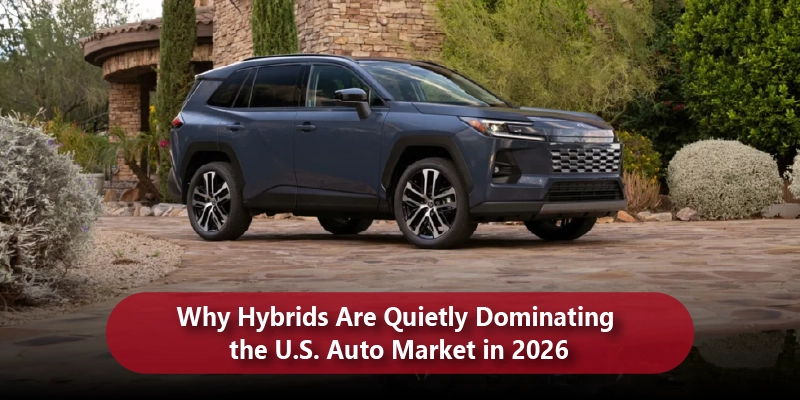
Hybrid cars dominate 2026 as buyers prefer fuel savings, reliability, and flexibility over EV charging limitations and range concerns.
The Shift Toward Practical Mobility
The automotive market in 2026 is no longer shaped by early adopter enthusiasm or innovation hype, and it is increasingly defined by measured, practical decision-making. Buyers today are evaluating vehicles through the lens of total ownership experience rather than future promise. While electric vehicles continue to advance in technology and adoption, a significant portion of consumers are gravitating toward hybrids as a more balanced, low-risk solution that fits seamlessly into their daily lives.
Hybrid vehicles have clearly moved beyond their earlier perception as transitional or in-between technology. They have matured into a mainstream, high-value segment that directly addresses real-world driving conditions. By intelligently combining internal combustion engines with electric motors, hybrids deliver strong fuel efficiency, extended driving range, and operational flexibility, all without requiring major lifestyle adjustments. This makes them particularly appealing to buyers who want to benefit from electrification without fully committing to the infrastructure and planning that EVs demand.
Across the United States, this shift is becoming increasingly visible at the retail level. Dealerships are reporting faster inventory turnover and shorter lot times for hybrid models, with some vehicles being reserved even before arrival. This demand is not driven by novelty, but by clear, functional advantages. Consumers are prioritizing predictable fuel savings, ease of refueling, and long-term reliability over the uncertainties that can come with early-stage EV adoption.
Ultimately, this trend highlights a broader evolution in consumer mindset. Cost efficiency, day-to-day convenience, and dependable usability are now taking precedence over experimentation and trend-following. Hybrids, by offering a practical blend of proven engineering and modern efficiency, are aligning perfectly with these priorities, positioning themselves not just as an alternative but as a preferred choice in the current automotive landscape.
Why Hybrid Cars Are Dominating the Market in 2026
The rise of hybrids is not accidental. It is the result of multiple market forces aligning at the right time.
1. Real-World Cost Efficiency
Fuel prices remain unpredictable, and inflation continues to impact household budgets. Hybrid vehicles offer immediate savings through significantly improved fuel economy, often exceeding 45-50 MPG.
Unlike EVs, hybrids do not require additional investment in home charging infrastructure, making them financially accessible to a wider audience.
2. No Dependency on Charging Infrastructure
One of the biggest barriers to EV adoption remains charging reliability. Public charging networks, while expanding, still lack consistency in availability and speed.
Hybrids eliminate this concern. Drivers can refuel at any gas station while still benefiting from electric-assisted driving in urban conditions.
3. Improved Technology and Performance
Modern hybrids are engineered for performance as well as efficiency. Instant torque from electric motors enhances acceleration, while advanced powertrain management ensures seamless transitions between gas and electric modes.
This makes today’s hybrids far more refined than earlier generations, both in driving dynamics and user experience.
4. Broader Product Availability
Manufacturers have significantly expanded their hybrid offerings. What was once limited to compact sedans now includes:
- Full-size SUVs
- Pickup trucks
- Luxury crossovers
This diversification has positioned hybrids as a default choice rather than a niche alternative.
Best Hybrid Cars to Consider in 2026
The current lineup of hybrid vehicles reflects how far the segment has evolved. These models stand out for their balance of efficiency, comfort, and performance:
- Toyota Camry Hybrid: A benchmark sedan offering excellent fuel economy, refined interiors, and long-term reliability.
- Honda Civic Hybrid combines sporty handling with impressive efficiency, ideal for daily commuting.
- Hyundai Palisade Hybrid: A three-row SUV delivering family-friendly space with reduced fuel consumption.
- Ford Maverick Hybrid: A compact pickup redefining utility with exceptional city mileage.
These vehicles demonstrate that hybrids are no longer limited by compromise, and they now compete directly with both gasoline and electric vehicles in performance and features.
Key Benefits of Choosing a Hybrid Vehicle
Balanced Efficiency Without Lifestyle Changes
Hybrid owners benefit from electric driving in traffic while maintaining the long-range capability of gasoline engines. This dual capability eliminates the need for route planning around charging stations.
Strong Resale Value
Market data indicates that hybrid vehicles retain value better than many traditional internal combustion models. Increased demand and proven reliability contribute to their strong resale performance.
Lower Maintenance Over Time
Hybrid systems reduce engine strain through electric assistance. This leads to less wear on components such as brakes and engines, ultimately lowering maintenance costs.
Immediate Financial Impact
Unlike EV incentives, which may vary by region, hybrid savings are immediate and consistent through reduced fuel consumption.
Why Hybrid Cars Appeal to Modern Families
For families, vehicle choice is less about experimentation and more about dependability. Hybrids align closely with these expectations.
They offer quiet operation in city environments, making them ideal for daily commutes and school runs. At the same time, they provide the flexibility needed for long-distance travel without logistical complications.
Safety is another key factor. Most hybrid models in 2026 come equipped with advanced driver assistance systems, including adaptive cruise control, lane-keeping assist, and collision mitigation technologies.
Additionally, hybrids present a more balanced environmental impact. While EVs eliminate tailpipe emissions, hybrids reduce emissions without requiring large battery production, which carries its own environmental cost.
Common Mistakes Buyers Should Avoid
Even with growing awareness, buyers often overlook critical aspects when choosing a hybrid:
- Confusing HEVs and PHEVs: Standard hybrids do not require charging, while plug-in hybrids do. Selecting the wrong type can lead to inconvenience.
- Underestimating Performance: Modern hybrids deliver strong acceleration due to electric torque. They are not slow vehicles.
- Ignoring Warranty Coverage: Battery warranties typically range between 8 and 10 years. Verifying this is essential for long-term peace of mind.
Understanding these factors ensures buyers maximize the benefits of hybrid ownership.
Market Outlook: Will Hybrid Growth Continue?
Industry analysts expect hybrid adoption to continue rising steadily through the remainder of the decade, driven by a combination of consumer demand, regulatory flexibility, and manufacturer strategy. As automakers refine their electrification roadmaps, hybrids are increasingly positioned as a scalable, production-friendly solution that can be deployed across multiple vehicle segments without the supply chain constraints associated with large EV batteries.
This scalability allows manufacturers to meet tightening emissions standards while still maintaining profitability and production stability. At the same time, continuous improvements in battery efficiency, powertrain integration, and lightweight engineering are making modern hybrids even more capable, further strengthening their market position.
While EV infrastructure is expected to expand significantly in the coming years, challenges around charging speed, grid capacity, and rural accessibility persist. Until these gaps are fully addressed, hybrids offer a practical bridge that requires no behavioral change from consumers, making them especially attractive to first-time electrification buyers.
Rather than serving as a short-term transition, hybrids are now evolving into a long-term cornerstone of the automotive ecosystem. They provide an immediate pathway to reduce emissions at scale while supporting a gradual and sustainable shift toward full electrification, ensuring that both consumers and manufacturers can adapt without disruption.
Hybrid vs EV vs Gasoline Vehicles (2026)
| Feature | Hybrid Vehicles | Electric Vehicles (EVs) | Gasoline Vehicles |
| Fuel Efficiency | Very High (45-55 MPG) | Extremely High | Moderate |
| Charging Requirement | None | Required | None |
| Driving Range | 500 – 700 miles | 250 – 400 miles | 400 – 600 miles |
| Maintenance Costs | Low | Low | Moderate to High |
| Infrastructure Dependency | Low | High | Low |
| Upfront Cost | Moderate | High | Moderate |
| Resale Value | High | Moderate | Moderate |
Frequently Asked Questions
Why are hybrids more popular than EVs in 2026?
They offer fuel savings without charging dependency or range limitations.
Which hybrid brands are leading the market?
Toyota, Honda, and Hyundai dominate with reliable and efficient models.
Are hybrids suitable for long-distance travel?
Yes, they combine electric efficiency with gasoline range for uninterrupted trips.
Do hybrids require charging?
Standard hybrids do not require external charging.
Are hybrid batteries expensive to replace?
Costs exist, but warranties typically cover 8-10 years, reducing risk.
Key Takeaways
- Hybrids have become the most practical choice for everyday drivers in 2026.
- They deliver a strong balance between efficiency, cost, and convenience.
- Expanding model availability has made hybrids accessible across all segments.
- Consumer preference is shifting toward reliability over experimentation.
- Hybrids eliminate range anxiety while still offering significant fuel savings.
- Advancements in hybrid technology have improved performance, making them comparable to traditional gas vehicles.
- Strong resale value makes hybrids a financially secure investment.
- Automakers are prioritizing hybrids as a core part of their electrification strategy.
- Infrastructure limitations for EVs continue to position hybrids as the more practical near-term solution.
- Hybrid systems provide a smoother and quieter driving experience in urban conditions.
Get More Updated Automotive Insights at Askaboutcars!
For More Car-Related Blogs: Night Driving Tips: How to Stay Safe on U.S. HighwaysBest Used Cars Under $15,000 in the U.S. That Still Feel Brand New (2026 Guide)Why Chinese EVs Are Almost Banned in the U.S. – What It Means for Car Buyers in 2026