


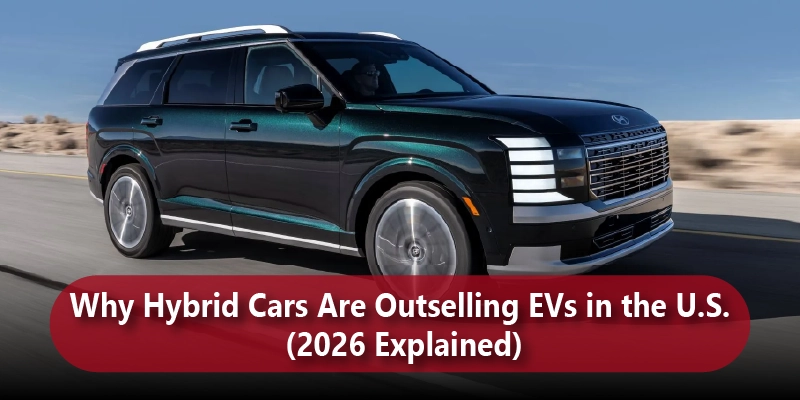
Hybrids are outselling EVs in 2026 due to lower cost, no charging hassles, better resale value, and practical everyday usability for most U.S. drivers.
For years, electric vehicles were positioned as the inevitable future of transportation. Governments pushed incentives, automakers invested billions, and consumers embraced the idea of zero-emission driving. However, as we move through 2026, a surprising trend has taken hold in the United States. Hybrids are outperforming EVs in both demand and growth.
This shift is not about abandoning electrification. Instead, it reflects a deeper evolution in consumer behavior. Buyers are no longer driven purely by environmental aspirations, and they are making decisions based on cost efficiency, convenience, and real-world usability.
Hybrids, once seen as a transitional technology, have now become the preferred choice for a significant portion of the market.
Understanding the 2026 Automotive Market Shift
The slowdown in EV adoption is not due to a single factor but rather a combination of economic, infrastructural, and behavioral realities.
In late 2025, the expiration of major federal EV tax credits changed the pricing landscape dramatically. Vehicles that once seemed competitively priced suddenly became less accessible to the average buyer. At the same time, inflation and higher interest rates made affordability a primary concern. Meanwhile, the hybrid segment matured. Automakers refined hybrid systems to deliver exceptional fuel efficiency, smoother driving experiences, and improved reliability. This evolution made hybrids more appealing than ever before.
The result is a market where consumers are no longer choosing between gasoline and electric but are choosing a balanced solution.
Also Read: Can BYD Beat Tesla in the U.S.? The Truth Behind America’s EV Battle
Why Hybrids Are Gaining Popularity in 2026
Affordability That Matches Consumer Expectations
Price remains the most influential factor in vehicle purchases. In 2026, hybrids typically cost significantly less than long-range EVs. Without federal incentives, the price gap has widened, making hybrids the more accessible option for middle-income households. Additionally, financing costs have increased, further amplifying the importance of lower upfront pricing.
No Dependency on Charging Infrastructure
One of the biggest barriers to EV adoption continues to be charging infrastructure. While urban areas have seen improvements, many suburban and rural regions still lack reliable fast-charging networks. Hybrids eliminate this concern. Drivers can refuel quickly at traditional gas stations while still benefiting from electric efficiency in city driving.
This flexibility is a key reason why many buyers are choosing hybrids over EVs.
Freedom from Range Anxiety
Range anxiety remains a psychological and practical issue for EV buyers. While modern EVs offer impressive range figures, real-world conditions such as highway speeds, weather, and air conditioning can significantly reduce those numbers.
Hybrids provide a seamless solution. The combination of an electric motor and a gasoline engine ensures that drivers never have to worry about being stranded due to a depleted battery.
Stable and Predictable Resale Value
The used car market in 2026 has shown noticeable volatility in EV pricing. Rapid technological advancements and battery depreciation concerns have led to fluctuating resale values. In contrast, hybrids have maintained strong and consistent resale performance. Buyers view them as a safer long-term investment, which further boosts their appeal.
Improved Real-World Efficiency
Modern hybrids are capable of delivering over 50 miles per gallon in everyday driving conditions. This level of efficiency significantly reduces fuel costs without requiring any behavioral changes from the driver. For many consumers, this represents the best of both worlds, where lower emissions without the inconvenience of charging.
The Reality of EV Infrastructure in 2026
Despite large-scale investments in charging networks, infrastructure development has not kept pace with consumer expectations.
Many regions still face gaps in fast-charging availability. Even in areas where chargers are present, reliability remains a concern, with reports indicating that a portion of public charging stations are frequently out of service.
Additionally, peak electricity pricing in some states has reduced the cost advantage of EVs, making them less economical than initially anticipated. These challenges have made hybrids a more dependable option for everyday use.
Hybrid vs EV: Practical Comparison for 2026 Buyers
| Feature | Hybrid Vehicles | Electric Vehicles (EVs) |
| Upfront Cost | Lower | Higher without incentives |
| Fueling/Charging | Gas and self-charging | Requires charging infrastructure |
| Range | Unlimited (gas backup) | Limited by battery |
| Maintenance | Moderate | Lower but specialized |
| Resale Value | Stable | Volatile in 2026 |
| Infrastructure Dependency | None | High |
| Long Trips | Easy | Requires planning |
Common Buyer Mistakes in 2026
Many consumers approach the hybrid vs EV decision with outdated assumptions. This often leads to dissatisfaction after purchase.
One common mistake is underestimating the total cost of EV ownership. Beyond the purchase price, buyers may need to invest in home charging equipment or electrical upgrades.
Another issue is overestimating real-world EV range. Factors such as climate and driving style can significantly impact battery performance.
On the other hand, hybrids are sometimes overlooked due to outdated perceptions. Modern hybrid systems deliver strong acceleration, refined performance, and advanced technology, making them far from the compromise vehicles they were once considered.
Also Read: Top 7 Reasons Your Check Engine Light Turns On (And What to Do Next)
Are Hybrids Better for the Environment?
Electric vehicles produce zero tailpipe emissions, which makes them highly effective at reducing urban air pollution and improving city air quality. This is particularly important in densely populated areas where vehicle emissions directly impact public health. However, the environmental cost of producing EVs, especially their large lithium-ion batteries, is substantial. Battery manufacturing involves energy-intensive processes and the extraction of raw materials such as lithium, cobalt, and nickel, all of which contribute to the vehicle’s initial carbon footprint.
Another important factor in 2026 is the source of electricity used to charge EVs. In regions where the power grid is still heavily dependent on fossil fuels, the overall environmental benefit of EVs can be less pronounced. In contrast, hybrids maintain consistent efficiency regardless of grid conditions, making their environmental performance more predictable.
As a result, many experts are now focusing on maximizing total emissions reduction across the entire vehicle ecosystem rather than promoting a single technology as the universal solution. In the current landscape, a diversified approach where hybrids play a significant role alongside EVs is often seen as the most effective path toward meaningful and immediate environmental impact.
Future Outlook: Will EVs Catch Up Again?
The current dominance of hybrids in 2026 does not indicate that electric vehicles are becoming obsolete or losing long-term relevance. Instead, it reflects a transitional phase in the automotive industry where consumers are prioritizing practicality over early adoption of emerging technologies. While EVs continue to represent the end goal of zero-emission mobility, the ecosystem required to support them at scale is still evolving.
Key advancements on the horizon, such as solid-state batteries with higher energy density, significantly reduced charging times, and improved durability, are expected to address many of the current limitations associated with EV ownership. In parallel, ongoing investments in fast-charging networks and grid infrastructure will play a critical role in making EVs more convenient and accessible across both urban and rural regions.
However, these improvements will take time to mature and reach price parity for the average consumer. Until then, hybrids offer a balanced and immediately viable alternative. They allow drivers to benefit from electrification without depending on external infrastructure or making major lifestyle adjustments.
Frequently Asked Questions
1. Why are hybrids outselling EVs in 2026?
Hybrids are cheaper, easier to use, and don’t depend on charging infrastructure.
2. Are EVs still worth buying in 2026?
Yes, especially for urban users with reliable home charging access.
3. Do hybrids save more money than EVs?
In many cases, hybrids offer better overall value due to lower upfront costs.
4. Is range anxiety still a problem in 2026?
Yes, particularly in rural and long-distance driving scenarios.
5. Will EV prices drop again?
Prices may decrease as battery technology improves and production scales up.
Key Takeaways
- Hybrids are outperforming EVs in 2026 primarily due to lower upfront costs and better affordability for mass-market buyers.
- The absence of reliable charging infrastructure in many regions continues to limit EV adoption.
- Hybrids eliminate range anxiety, offering uninterrupted driving with both electric and gasoline power.
- Resale value stability makes hybrids a safer long-term investment compared to fluctuating EV prices.
- Modern hybrids deliver 50+ MPG efficiency, reducing fuel costs without requiring lifestyle changes.
- EVs remain a strong option for urban users, but hybrids currently provide a more practical, flexible solution for everyday driving.
- The market trend reflects a shift toward practical electrification, rather than full electrification in the near term.
Get More Updated Automotive Insights at Ask About Cars!
For More Car-Related Blogs:
Best Used Cars Under $15,000 in the U.S. That Still Feel Brand New (2026 Guide)
