


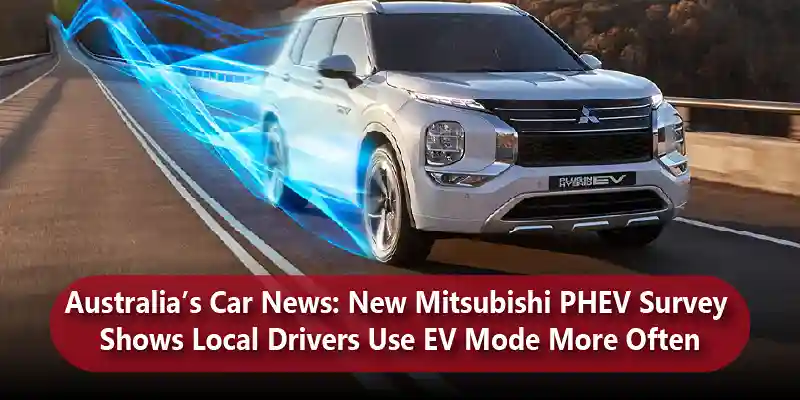
The Australian automotive landscape is undergoing a silent transformation. For years, the conversation around the electric transition was dominated by pure battery-electric vehicles and the infrastructure hurdles that came with them. However, the latest electric car news Australia highlights a surprising frontrunner in the race for decarbonization with the plug-in hybrid.

A groundbreaking Australian car buyers survey recently commissioned by Mitsubishi Motors Australia has shattered long-held myths about how these vehicles are used. While critics once claimed that plug-in hybrids were merely compliance cars rarely charged by their owners, the data shows that Australian drivers are embracing EV mode driving in Australia with unexpected enthusiasm.
The 81% Statistic: How Aussies Are Outpacing the World
The centerpiece of the study, which surveyed nearly 900 owners of the Mitsubishi PHEV Australia lineup, revealed that Outlander PHEV drivers are operating in pure electric mode for a staggering 81% of their total driving time. Owners of the smaller Eclipse Cross PHEV weren’t far behind, clocking in at 75%. This data is particularly significant when compared to global trends. In Europe, where PHEVs have been popular for nearly a decade, studies often show EV mode usage hovering around 45% to 49%. The fact that Australians are nearly doubling that figure suggests a unique synergy between the Mitsubishi Outlander PHEV Australia specs and the daily commuting habits of local drivers.
Why the Mitsubishi Outlander PHEV is Dominating the Driveway
The success of the Mitsubishi PHEV Australia strategy relies heavily on its flagship model. The latest Mitsubishi Outlander PHEV range is a key factor in why owners are staying off the petrol pump. With a class-leading electric-only range of up to 84km, the vehicle comfortably covers the average Australian daily commute, which typically sits under 40km.
- Battery Capacity: The 20kWh lithium-ion battery provides enough strength for a full day of suburban running.
- Charging Habits: The survey found that 97% of owners charge their vehicles at home, with over half charging every single day.
- Ease of Use: Most owners utilize a standard domestic power point for overnight charging, proving that expensive wallbox installations aren’t always a prerequisite for joining the EV movement.
By providing a petrol safety blanket for long-distance weekend trips to the coast or the bush, the plug-in hybrid Australia market offers a solution to the range anxiety that still plagues many potential BEV buyers.
PHEV Sales Australia: A Market in Hyper-Growth
The shift in driver behavior is reflected in the showroom. PHEV sales in Australia have seen a meteoric rise, with 2025 data showing a triple-digit percentage increase year-on-year. While brands like BYD have entered the fray with the Shark 6 and Sealion 6, Mitsubishi remains a cornerstone of the segment, holding a significant portion of the hybrid SUV Australia market share.
The surge in interest comes at a pivotal time. As the Federal Government implements the New Vehicle Efficiency Standard, manufacturers are under pressure to lower their fleet emissions. For many families, the Mitsubishi Outlander PHEV Australia represents the perfect middle ground, and it offers the environmental benefits of an EV without requiring a total overhaul of their driving lifestyle.
EV vs Petrol Australia: The Economic Reality
When weighing up ev vs petrol in Australia, the argument used to be purely environmental. Today, it is increasingly economic. The Mitsubishi survey highlighted that lower running costs were the number one reason for purchase.
With petrol prices remaining volatile across the East Coast and Western Australia, the ability to refuel at home using off-peak electricity or solar power is a massive drawcard. Even when the petrol engine does kick in, the efficiency of a plug-in hybrid Australia remains superior to a traditional internal combustion engine vehicle, as the system acts as a highly efficient series hybrid.
As charging infrastructure continues to expand across regional Australia, these drivers will be the first to transition to full BEVs, having already mastered the habits of plugging in and managing electric range.
Living with a Hybrid SUV in Australia
The appeal of the hybrid SUV category in Australia extends beyond the powertrain to overall versatility, and the Outlander PHEV exemplifies this balance as a capable family hauler. It stands out with rare seven-seat flexibility at its price point, Mitsubishi’s Super-All Wheel Control system that preserves off-road capability and towing confidence, and Vehicle-to-Load functionality that allows the car’s battery to power household appliances, now a must-have feature for Australian campers and tradespeople.
Wrapping Up: The Future of the Aussie Commute
The latest electric car news in Australia confirms that the EV revolution doesn’t have to be an all-or-nothing proposition. The Mitsubishi survey proves that when given the right tools, Australian drivers are more than willing to do the right thing for the environment and their wallets. By utilizing EV mode driving, Australians for over 80% of their trips, Mitsubishi owners are effectively operating stealth EVs for the vast majority of the year, only calling on the petrol engine when the vastness of the Australian continent demands it. As the Mitsubishi PHEV Australia lineup continues to evolve, it remains the benchmark for how technology can meet the practical needs of local motorists.
Most Common Questions
1. What is the real-world Mitsubishi Outlander PHEV range in Australia?
The current Mitsubishi Outlander PHEV range is ADR-certified at 84km of pure electric driving. In real-world Australian conditions, most drivers report a consistent 65–75km, which easily covers the average daily commute.
2. How do PHEV sales in Australia compare to regular hybrids?
While traditional hybrids still sell in higher volumes, PHEV sales in Australia are growing at a faster percentage rate. This is due to the increasing availability of models and the desire for drivers to have a plug-in option that allows for zero-emission daily driving.
3. Is a Mitsubishi PHEV Australia better than a petrol-only SUV?
When comparing EV vs petrol Australia, the PHEV offers significantly lower running costs and a smoother, quieter driving experience. While the initial purchase price is higher, the savings on fuel and the higher resale value of electrified vehicles often bridge the gap over a 3-to-5-year ownership period.
4. Can I charge my plug-in hybrid in Australia at a public fast charger?
Yes, the Mitsubishi Outlander PHEV Australia is one of the few PHEVs that supports DC fast charging, allowing you to charge from 0% to 80% in about 38 minutes. However, most owners find it most convenient to charge at home using a standard 240V socket.
5. What did the latest Australian car buyers survey reveal about EV mode?
The Australian car buyers survey commissioned by Mitsubishi revealed that owners are highly diligent, using ev mode driving in Australia for up to 81% of their travel. This dispels the myth that PHEVs are rarely plugged in and highlights their effectiveness in reducing urban tailpipe emissions.
For more expert hacks on maximizing your battery life or tips on the best local charging spots, join the conversation at Ask about cars.
For More Related Blogs:


