


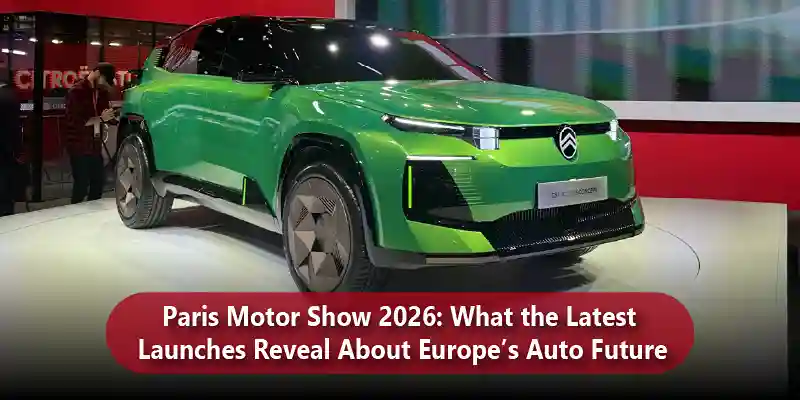
Paris Motor Show 2026 marks a turning point for Europe’s automotive industry, where affordable electrification moves from promise to production, hydrogen steps out of the lab and onto the show floor, and European manufacturers double down on resilience amid intensifying global competition.

The 91st edition of the Mondial de l’Auto, held in Paris from October 12 to 18, 2026, is more than a showcase of new models, and it’s a stress test for the European car market in 2026. As industry leaders and enthusiasts converge at Porte de Versailles, one message is clear: Europe is no longer just envisioning a greener mobility future; it is actively building the infrastructure, technology, and industrial strategy to deliver it.
How is the Paris Motor Show 2026 Reshaping the Global Market?
The Paris Motor Show 2026 is not merely an exhibition; it is a strategic counter-offensive. With new car launches in Europe 2026 focusing on B-segment affordability and high-performance sustainability, the show reveals how legacy automakers are pivoting to maintain dominance.
- The Rise of Affordable EVs: Brands like Renault and Dacia are using Paris auto show launches to debut mass-market electric cars Europe can actually afford, targeting the sub-€25,000 price bracket.
- The Hybrid Safety Net: Recognizing that charging infrastructure is still scaling, hybrid cars in Europe remain a centerpiece, providing a transitional bridge for consumers not ready for full BEV adoption.
- Technological Sovereignty: The focus has shifted toward European-made battery tech and software-defined vehicles to reduce reliance on external supply chains.
Key Signals Shaping Europe’s Automotive Direction
The latest vehicle debuts point to an industry recalibrating rather than reinventing itself. Across the show floor, European automakers are prioritizing execution over experimentation, blending regulatory readiness with commercial realism.
Electrification remains central, but it is increasingly framed around affordability, scalability, and infrastructure compatibility rather than outright disruption. Advanced hybrids are positioned as long-term bridge technologies, not short-term compromises, reflecting a more disciplined transition strategy.
Design language and product storytelling also signal a strategic pivot. Many new concepts lean heavily on European brand heritage, craftsmanship, and motorsport lineage, while integrating AI-powered interiors, software-defined features, and digital personalization clearly aimed at defending brand identity in a crowded global market.
Which Concept Cars Stole the Spotlight?
The concept cars Paris Motor Show organizers unveiled this year aren’t just shelfware but blueprints for production.
- Renault 4 E-Tech: A retro-futuristic icon reimagined for the electric cars Europe segment.
- Ferrari Elettrica: Marking a historic shift for the Maranello brand, proving performance and silence can coexist.
- BMW Neue Klasse Evolutions: Showcasing how the European car market in 2026 will prioritize circular economy materials and 100% recyclable components.
What are the Dominant Automotive Trends Europe is Facing?
The automotive trends Europe is witnessing in 2026 revolve around connectivity and the Third Living Space. Cars are no longer just transport; they are mobile offices and entertainment hubs.
- Software-Defined Everything: Over-the-air updates are now standard, allowing cars to age gracefully with new features.
- Ultra-Fast Charging: New models launched in Paris boast 10-to-80% charge times in under 15 minutes.
- Micro-Mobility Integration: Large SUVs are now being designed with dedicated bays for electric scooters or folding e-bikes.
Why are Electric and Hybrid Cars Europe’s Primary Focus?
The European car market 2026 is currently balanced on a knife-edge between total electrification and bridge technologies.
- In Europe, electric cars are seeing a second wave of adoption as the second-hand market matures and new entry-level models arrive.
- Hybrid cars in Europe are becoming the Goldilocks solution for families who travel long distances but want to commute silently on electric power.
- Government incentives are shifting from purchase subsidies to infrastructure support, making Paris auto show launches with high-speed charging capabilities more attractive.
Common Mistakes to Avoid When Tracking Auto Trends
- Waiting for the Perfect Battery: Solid-state tech is coming, but current lithium-ion models at the Paris Motor Show 2026 are more than sufficient for 99% of users.
- Ignoring Software Support: A car with a poor operating system will lose value faster than one with a smaller battery.
- Underestimating the Resale of Hybrids: In the European car market in 2026, a high-quality hybrid often holds its value better than a pure ICE or early-gen EV.
Expert Insight: The Paris Motor Show 2026 marks the end of the spec-war and the beginning of the ‘user-experience war’ for European manufacturers.
Frequently Asked Questions
The most significant takeaway is the price war triggered by new car launches in Europe 2026, making high-quality electric cars in Europe accessible to a much broader demographic.
Absolutely. Europe accounted for a significant portion of the Paris auto show launches, serving as a critical bridge for those without home charging.
These concept cars showcase the design language and software-first architecture that will dominate the European car market in 2026 and beyond.
The main automotive trends Europe is seeing include vehicle-to-grid technology, the use of sustainable or recycled interior materials, and ultra-compact urban EVs.
With the current new car launches in Europe 2026, the technology has stabilized enough that now is an excellent time to buy, especially with the advancements in battery longevity shown this year.
Key Takeaways
- The Paris Motor Show 2026 highlights a shift toward “affordable luxury” and accessible electrification.
- Electric cars in Europe are now focusing on efficiency and charging speed rather than just massive battery size.
- Hybrid cars in Europe are evolving with longer electric ranges, making them viable for both city and long-haul driving.
- The European auto industry’s future is increasingly reliant on software-defined platforms and over-the-air updates.
- Automotive trends in Europe show a move toward smaller, more agile vehicles suited for modern urban environments.
- Sustainability is now a core design pillar, with concept cars Paris Motor Show utilizing bio-based and recycled materials.
- The European car market in 2026 is becoming more competitive, forcing legacy brands to innovate faster than ever.
Join the conversation at Ask About Cars, where industry insights, expert opinions, and real-world automotive discussions come together.
For More Car-Related Blogs:
Ford & Geely: What Global Auto Alliances Mean for Buyers in Europe
EVs Overtake Gas Cars in Europe: What It Means Globally in 2026
Mazda Delays EVs to 2029: Smart Move or Strategic Risk?
Have insights or experiences to share? Submit your blog through the link below and become part of our automotive community: https://askaboutcars.com/submit-blog/
