

EVs offer lower long-term ownership costs with home charging, while hybrids remain cheaper upfront and safer for short-term owners.

The EV vs Hybrid America debate in 2026 is no longer about environmental preference, and it is about financial structure, infrastructure access, and ownership strategy. With gasoline averaging roughly $2.93 per gallon and residential electricity rates ranging between $0.27 and $0.38 per kWh, the cost gap between electric vehicles and hybrid electric vehicles has narrowed significantly.
However, narrowing does not mean equal.
The better financial choice now depends on five core variables:
- Upfront purchase price
- Fuel or electricity cost
- Maintenance expense
- Incentives and tax positioning
- Depreciation and resale stability
This guide breaks down the total cost of ownership over a 5-7 year horizon to determine where each powertrain truly wins.
Upfront Purchase Price: The Capital Commitment
The first and most visible difference between EVs and hybrids is MSRP.
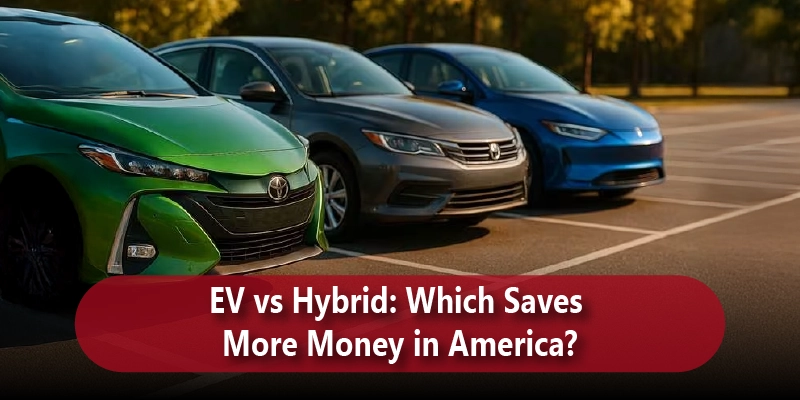
For example, the Toyota Prius remains one of the most cost-effective hybrid options in the American market. In contrast, most mainstream EVs remain significantly more expensive due to battery pack costs and platform development.
Average 2026 MSRP
- Electric Vehicle (EV): ~$61,000
- Hybrid (HEV): ~$32,000
That nearly $29,000 difference has a dramatic impact on the financing structure, loan interest, and early depreciation exposure.
Financial implication:
An EV buyer must recover this upfront premium through fuel savings, lower maintenance, and tax advantages, which typically requires 5 to 8 years of ownership. Hybrids, by contrast, generate immediate affordability and reduce financial risk for buyers who drive vehicles frequently.
Related Insights: 5 Best Hybrid Cars in America 2026
Fuel vs Electricity: The Real-World Operating Cost
Daily operating cost is where EVs can outperform, but only under the right conditions.
A highly efficient hybrid such as the Toyota Prius can achieve around 57 MPG. Yet it remains exposed to gasoline price volatility.
Estimated Per-Mile Operating Cost (2026)
| Scenario | Cost Per Mile |
| EV Home Charging @ $0.16/kWh off-peak | ~$0.06 |
| EV Average Residential Rate $0.32/kWh | ~$0.10 |
| EV Public DC Fast Charging | ~$0.20+ |
| Hybrid 57 MPG @ $2.93/gal | ~$0.07-$0.09 |
Key Insight
- Home charging leads to a structural advantage for EVs.
- Public fast charging boosts up to a cost parity or disadvantage.
If you rely heavily on DC fast chargers, which can range from $0.65-$0.87 per kWh, the EV fuel savings advantage can disappear entirely.
Charging Access: The Economic Multiplier
Home Charging Infrastructure in Place
Electricity costs remain predictable and low, allowing EV owners to generate $700–$1,600 in annual fuel savings compared to gasoline vehicles.
No Private Charging (Apartment or Street Parking)
Dependence on public DC fast chargers increases per-mile energy costs, often eliminating the EV fuel advantage and making hybrids financially more efficient.
Mixed Charging (Home & Occasional Fast Charging)
EV retains a moderate cost advantage, but savings shrink depending on the frequency of public charger use.
Access to reliable, low-cost home charging is the primary financial driver that determines whether an EV meaningfully outperforms a hybrid in total cost of ownership.
Maintenance: Mechanical Simplicity vs Dual Systems
Maintenance costs accumulate quietly but significantly over time.
EV Maintenance Advantages
EVs eliminate several high-frequency service requirements:
- No oil changes
- No spark plugs
- No exhaust system
- No transmission servicing in most designs
- Reduced brake wear due to regenerative braking
Over five years, EV maintenance is typically 30-40% lower than hybrid maintenance.
Hybrid Maintenance Reality
Hybrids combine:
- Internal combustion engine
- Electric motor
- Oil systems
- Emissions hardware
While hybrids are highly reliable, maintaining two propulsion systems introduces additional service requirements.
Incentives & Tax Structure in 2026
The previous federal $7,500 EV credit framework changed significantly following the implementation of the One Big Beautiful Bill Act.
What Replaced It?
- Up to $10,000 annual loan interest deduction
- Primarily applies to American-made EVs
- Income caps ~$100,000 for single filers)
- Most standard hybrids do not qualify
This shift makes EV savings more dependent on income level and financing structure rather than point-of-sale discounts.
Strategic implication:
Higher earners who finance EVs benefit more under the current system.
Depreciation & Resale Value
Depreciation is often the highest hidden cost of vehicle ownership.
Depreciation & Resale Trends (2026)
| Factor | EV | Hybrid |
| 3-Year Depreciation | Higher | Moderate |
| 5-Year Value Retention | Improving | Strong |
| Used Market Stability | Volatile | Stable |
EVs experience steeper early depreciation, partly due to rapid technology advancement and battery concerns. Hybrids benefit from mature technology and broad consumer confidence.
Implication:
If you plan to sell within 3 years, hybrids usually present lower financial risk.
Insurance & Registration Costs
EV insurance premiums are often slightly higher due to:
- Battery replacement risk
- Advanced sensor systems
- Limited certified repair networks
Some states also impose EV registration surcharges of $200-$500 annually to offset lost gas tax revenue. Hybrids typically avoid these levies and may carry slightly lower insurance premiums.
7. Climate & Geographic Impact
Cold weather can reduce EV range by 20-30% due to thermal management and cabin heating demands. This increases energy consumption during the winter months.
Hybrids are less sensitive to temperature-related efficiency drops because they rely on internal combustion systems. In colder northern states, winter operating costs for EVs can increase noticeably.
Related Insights: SUVs, EVs, or Hybrids? What Americans Prefer in 2026
Five-Year Ownership Scenario
Below is a simplified operating cost model excluding purchase price.
5-Year Operating Cost Estimate
| Category | EV (Home Charging) | Hybrid |
| Fuel/Energy | ~$4,500 | ~$6,500 |
| Maintenance | ~$2,000 | ~$3,500 |
| Insurance | ~$9,000 | ~$8,000 |
| Registration | ~$1,500 | ~$900 |
| Total Operating | Lower long-term | Higher operational |
When ownership exceeds five years and charging is home-based, EVs typically generate net savings.
Common Financial Mistakes to Avoid
- Ignoring home charger installation costs about $500-$1,500
- Overbuying unnecessary long-range EV models
- Assuming public charging equals home charging economics
- Underestimating depreciation
- Forgetting state-specific EV registration surcharges
Strategic buyers model the total cost, not just fuel savings.
Key Takeaways
- EVs deliver maximum value when paired with home charging and long-term ownership.
- Hybrids remain the safest financial choice for short-term drivers.
- Charging infrastructure access determines EV profitability.
- Depreciation can outweigh fuel savings if ownership is brief.
- Tax incentives in 2026 favor higher-income EV buyers.
- Without consistent home charging, hybrid economics are typically superior.
Which One Should You Choose?
If you drive more than 15,000 miles annually, can charge at home, and plan to keep your vehicle at least 5-7 years, an EV can produce meaningful long-term savings. If you lack charging access, prioritize lower upfront cost, or trade vehicles every 2-3 years, a hybrid remains the financially safer decision. Run your numbers carefully, where the smartest vehicle choice is the one aligned with your ownership strategy, not market trends.
Get More Updated Automotive Insights at Ask About Cars!
Have insights or experiences to share? Submit your blog through the link below and become part of our automotive community.