


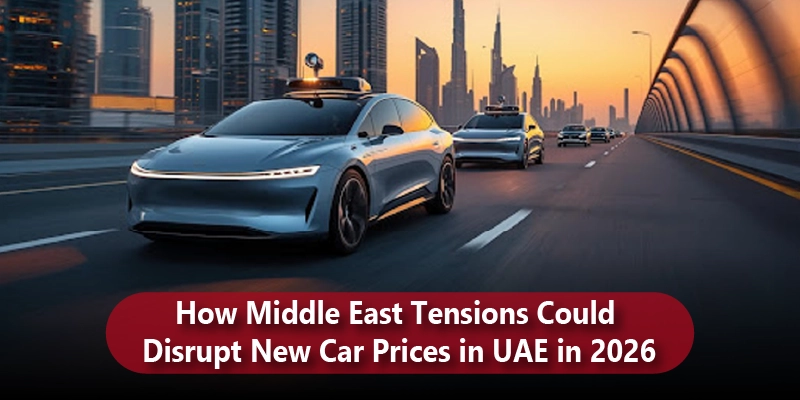
Rising Middle East tensions in 2026 are increasing UAE car prices due to shipping route disruptions, higher marine insurance premiums, oil price volatility, and supply chain delays.

Why This Matters in 2026
The UAE automotive market has historically been resilient, fueled by strong import infrastructure, global brand access, and high consumer demand. However, 2026 has introduced a new macroeconomic variable: sustained geopolitical instability in critical maritime corridors.
For buyers planning to purchase a new vehicle this year, understanding how Middle East tensions affect car prices in the UAE is not speculation; it is cost management.
The price you see in a showroom today reflects global shipping risk, energy markets, insurance premiums, and international supplier dependencies.
1. Maritime Disruptions and Import Costs
The UAE imports the majority of its vehicles from Asia, Europe, and North America. These shipments rely heavily on two critical routes:
- Strait of Hormuz
- Red Sea
When regional tensions escalate:
- Cargo insurers increase war-risk premiums
- Shipping companies reroute vessels
- Transit times increase by 10-20 days
- Freight costs per container rise significantly
Diversions around the Cape of Good Hope add fuel, crew time, and operational risk. These added costs are passed from shipping companies to distributors and eventually to consumers in the UAE. Higher landed cost per vehicle before it even reaches port.
2. Oil Price Volatility and Manufacturing Costs
Geopolitical instability often causes oil price spikes. Oil impacts vehicle pricing in two ways:
Logistics Cost
Fuel is a direct input in:
- Ocean freight
- Land transport
- Port operations
Manufacturing Inputs
Petrochemicals are used in:
- Synthetic rubber tires
- Plastics, interiors, dashboards
- Paint coatings
- Wiring insulation
When crude prices surge, manufacturing costs rise. Automakers may initially absorb part of the increase, but prolonged volatility leads to price adjustments. This explains why even vehicles assembled outside the Middle East are still affected by regional conflict.
3. Insurance and Financial Risk Premiums
Shipping insurers price geopolitical risk dynamically. When maritime routes are flagged as high-risk zones:
- Cargo insurance premiums increase
- Financing costs rise for large inventory shipments
- Importers require higher working capital
Dealers operating on thin margins adjust retail pricing accordingly. This layer is often overlooked but materially contributes to the UAE car price increase in 2026.
4. Supply Chain Compression and Allocation Limits
Modern automakers use just-in-time inventory systems.
- Microchips
- Transmission components
- EV battery modules
- Advanced safety sensors
If global production slows, markets like the UAE receive reduced allocation. In 2025, temporary oversupply gave buyers negotiating leverage. In 2026, allocation tightening is reversing that trend.
5. Segment-Specific Impact in the UAE
Different vehicle categories are affected differently.
| Segment | Primary Cost Driver | 2026 Impact Level |
| Luxury Cars | Specialized EU/US components, air freight | High |
| SUVs | Higher shipping volume and strong demand | Moderate to High |
| Electric Vehicles | Battery mineral imports and specialty logistics | Moderate |
| Economy Sedans | High production volume buffers costs | Mild to Moderate |
| Hybrid Vehicles | Complex dual systems | Moderate |
Luxury vehicles are particularly sensitive because they rely on multi-country component sourcing and low production volumes. SUVs remain popular in the UAE, and higher shipping weight increases freight exposure.
6. Electric Vehicles: Are They Protected?
Many assume EVs are insulated because they reduce fuel dependence. However, EV pricing depends heavily on:
- Lithium
- Nickel
- Cobalt
- Semiconductor components
These materials are globally traded and highly sensitive to logistics disruption. Battery packs also require temperature-controlled shipping and specialized handling, increasing freight costs. Therefore, EVs may experience moderate pricing pressure in 2026 despite long-term fuel savings benefits.
7. Dealer Pricing Behavior in 2026
Buyers should expect:
- More frequent price updates
- Shorter validity on quotations
- Reduced promotional discounts
- Higher booking deposits
- Limited customization availability
Dealerships are managing uncertainty by tightening margins and minimizing exposure to sudden cost swings.
8. UAE Vehicle Price Forecast: Mid to Late 2026
If maritime volatility persists:
- Prices likely remain elevated through Q4
- Discounts become model-specific rather than market-wide
- High-demand trims sell at or near MSRP
- Fleet buyers face longer wait times
If tensions de-escalate and shipping normalizes, stabilization may occur but rapid price declines are unlikely due to accumulated cost pressures.
9. Practical Buying Strategies for 2026
To reduce financial risk:
- Secure written price locks.
- Negotiate service packages instead of a base price.
- Consider in-stock vehicles over factory orders.
- Compare hybrid vs ICE on total cost of ownership.
- Monitor oil price trends before finalizing a purchase.
Frequently Asked Questions
Prices may stabilize only if maritime trade risks and oil volatility decline significantly.
Yes, higher freight costs and strong regional demand are increasing SUV pricing pressure.
Yes, battery mineral supply chains and specialized logistics make EVs sensitive to global disruptions.
If a vehicle is available at a pre-adjustment price, early purchase reduces exposure to future hikes.
For advertising, sponsored content, or brand collaboration opportunities on this platform please visit: Advertise with us.


