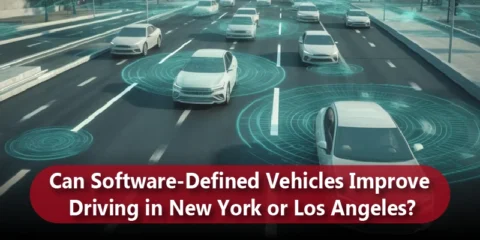



In short, the shift occurs because the automotive industry has reached a hardware plateau where traditional mechanical improvements and basic electrification no longer offer a competitive edge. At CES 2026, the focus has pivoted to intelligence specifically, physical AI, autonomous driving, and software-defined vehicles to create cars that are not just modes of transport, but computers on wheels that learn, adapt, and generate new revenue through digital services.

While the early 2020s were defined by the EV gold rush, CES 2026 in Las Vegas has marked a historic turning point. Automakers from Detroit to Tokyo are realizing that while batteries move the car, AI moves the needle for consumers. With Nvidia Automotive’s latest platforms and the rise of CES 2026 robot cars, the industry is now prioritizing brainpower over horsepower to navigate a market where software dictates the value of the vehicle.
Why Is the CES 2026 Auto Industry AI Shift Happening Now?
The transition isn’t just about cool gadgets; it is an economic necessity driven by three major factors: the slowdown in EV sales growth, the maturation of edge computing, and the demand for personalized user experiences.
The Strategic Logic Behind the Transformation:
- The Hardware Plateau: Traditional car manufacturing has become a low-margin commodity. Brands are integrating CES 2026 car technology like generative AI assistants to differentiate themselves from competitors.
- Data Monetization: Automakers can no longer survive on one-time sales. The rise of CES 2026 software-defined vehicles allows companies to sell subscription-based features and Over-the-Air updates.
- Safety Mandates: Global regulations are demanding smarter collision avoidance. CES 2026 autonomous driving systems have moved from experimental to production-ready, utilizing physical AI to reason through complex urban traffic.
- In-Cabin Intelligence: Drivers now expect their cars to act as personal assistants. CES 2026 AI automotive trends show a move toward Vision-Language Models that detect driver fatigue or health emergencies in real-time.
Also Read: CES 2026 Reveals What’s Next for Cars in the US
What Role Does Nvidia Automotive Play in This Transformation?
If the engine was the heart of the 20th-century car, the AI chip is the heart of the 2026 model. CES 2026 Nvidia Automotive announcements have centered on the Alpamayo platform, a specialized reasoning model designed for physical AI cars.
Key Advancements in AI Integration:
- Thinking, Not Just Sensing: Unlike older systems that just saw obstacles, Nvidia Automotive models now use reasoning to predict if a pedestrian will step into the street.
- Unified Architectures: Platforms like NVIDIA DRIVE Thor are consolidating the car’s brain, handling everything from the dashboard displays to Level 4 CES 2026 autonomous driving on a single chip.
- Simulation vs. Reality: Using digital twins, CES 2026 AI automotive trends show that cars are now driven billions of virtual miles before they ever touch a real road.
How Is CES 2026 EV AI Integration Changing the Driving Experience?
Electrification and AI are no longer separate silos. In 2026, CES 2026 EV AI integration is being used to solve the range anxiety and charging friction that plagued earlier electric models.
Key Benefits of AI-Driven EVs:
- Intelligent Range Estimation: By continuously assessing terrain, climate, and driver behavior, AI enhances confidence in electric vehicle range planning..
- Thermal Intelligence: Systems like ZF’s TempAI use neural networks to optimize battery temperature without needing extra physical sensors.
- Autonomous Charging: CES 2026 robot cars can now navigate to a charging pad and initiate a wireless charge without any human intervention.
Also Read: Top 10 Car Accessories Every Indian Driver Should Own in 2026
What are the Common Mistakes in the Shift to AI Technology?
While the excitement is high, the transition to CES 2026 car technology hasn’t been without its hurdles.
- Over-Reliance on the Cloud: Many early AI cars failed because they lost intelligence in tunnels or areas with poor 5G. The current trend is Edge AI, where the car processes data locally.
- Feature Creep: Adding too many screens and AI distractions can compromise driver focus.
- Neglecting Cybersecurity: As cars become software-defined vehicles, they become targets for hacking, requiring a security-first architecture.
Expert Insight: By 2026, the value of a car isn’t in its zero-to-sixty time; it’s in its lines of code. A vehicle that doesn’t receive monthly AI updates will depreciate faster than a flip phone in a smartphone world.
Frequently Asked Questions
Physical AI cars refer to vehicles equipped with AI models that don’t just process data but understand and interact with the physical laws of the world. They use “reasoning” to handle unpredictable scenarios, much like a human driver would.
Most CES 2026 robot cars are currently targeting Robotaxi fleets like Waymo or the new Tensor robocar. However, many Level 2+ AI features are arriving in consumer models like the Mercedes-Benz CLA this year.
CES 2026 software-defined vehicles allow the hardware to remain the same while the personality and capabilities of the car improve over time via software, similar to how your smartphone gets new features via OS updates.
While Qualcomm and Intel are huge players, at CES 2026, Nvidia Automotive leads in Physical AI and large-scale simulation, providing the end-to-end stack that many luxury OEMs prefer for high-level autonomy.
Initially, yes. CES 2026 data points to centralized AI platforms as a cost-efficient alternative to distributed vehicle computing, with potential savings of around 20% over the vehicle lifecycle.
Key Takeaways
- CES 2026 marks the end of the Car as a Machine and the beginning of the Car as an AI Agent.
- Physical AI and reasoning models from Nvidia Automotive are making Level 3 and Level 4 autonomy a practical reality.
- Software-defined vehicles are the new industry standard, prioritizing lifetime updates over mechanical specs.
- The CES 2026 AI shift is driven by the need for new revenue streams and increased safety.
- In-Cabin Intelligence is moving from voice commands to intent prediction, where the car knows what you want before you ask.
- Sustainability Meets AI: New CES 2026 EV AI integration is focusing on thermal intelligence to squeeze more range out of existing battery tech.
Join the conversation at Ask about cars to see which models are leading the pack!
For More Car-Related Blogs:
CES 2026 Reveals What’s Next for Cars in the US
Top 10 Car Accessories Every Indian Driver Should Own in 2026
Skipping Services? You Might Be Voiding Your Car Warranty Without Knowing