

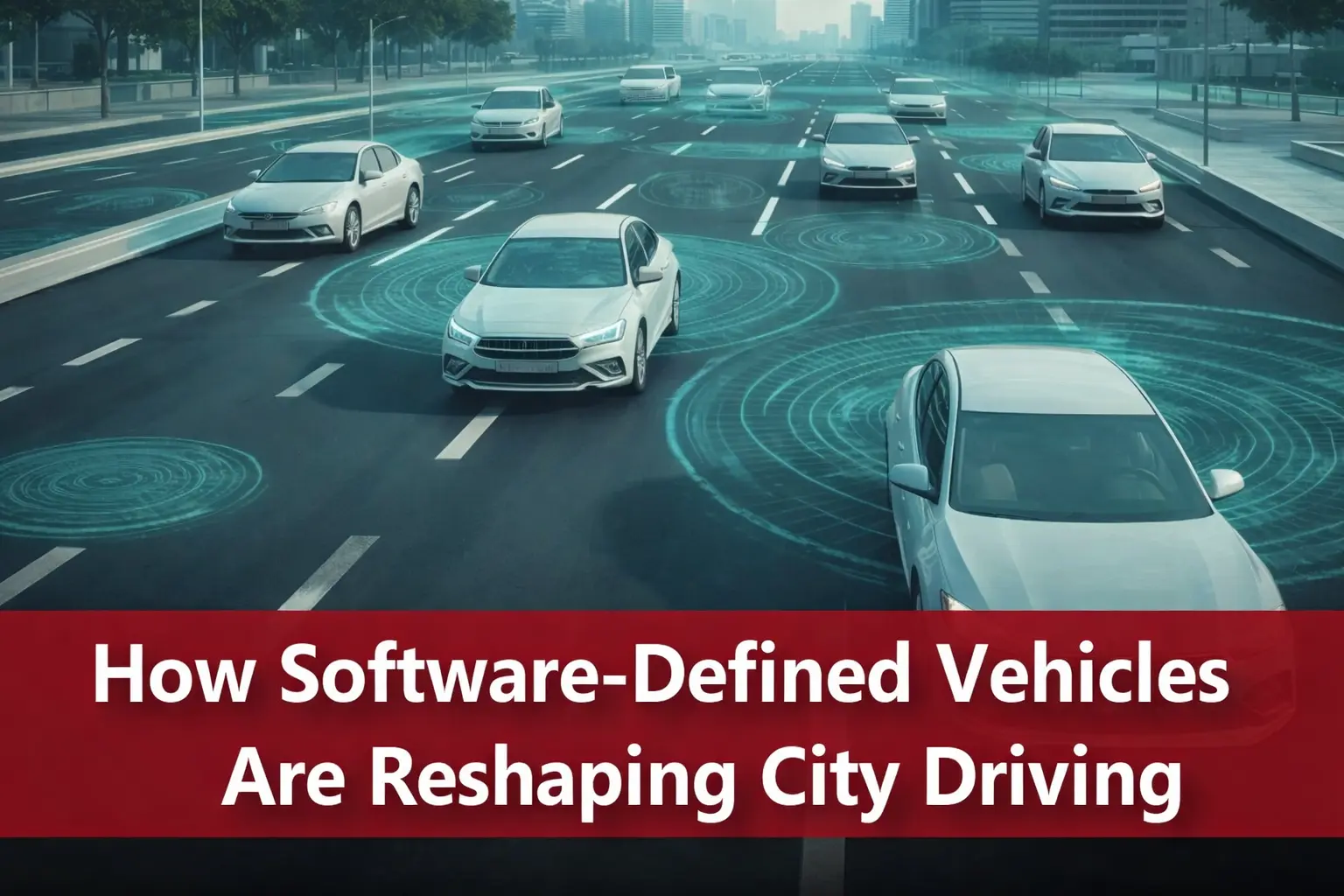
If you’ve driven in a busy city recently, you’ve probably noticed that cars feel… smarter. They brake more smoothly in traffic, warn you earlier about hazards, and even improve months after you buy them. That’s not coincidence. It’s the rise of software defined vehicles (SDVs) — cars where software, not hardware, does most of the thinking.

Urban driving puts cars under constant pressure: tight roads, unpredictable traffic, pedestrians everywhere, and endless stop‑and‑go movement. Software-defined vehicles are quickly becoming a core part of the future of mobility, especially as cities demand safer, smarter, and more adaptive driving solutions.
What Exactly Is a Software Defined Vehicle?
A software defined vehicle is a car built around software as its core system. Instead of locking features into hardware at the factory, SDVs use software to control driving assistance, safety systems, infotainment, navigation, and energy management.
The biggest difference?
SDVs don’t stay the same after you buy them.
They can:
- Receive over‑the‑air (OTA) updates
- Improve safety systems without recalls
- Adapt to traffic patterns and driving behavior
- Unlock new features months or years later
Think of it as the difference between an old mobile phone and a modern smartphone — one stays static, the other keeps evolving.
Why City Driving Needs Software Defined Cars
Cities are the toughest environment for any vehicle. Congestion, constant braking, narrow lanes, construction zones, cyclists, and pedestrians all demand instant reactions.
Traditional cars rely heavily on mechanical systems and fixed programming. SDVs, on the other hand, use real‑time data, sensors, and AI‑driven logic to respond dynamically to what’s happening around them.
This makes a huge difference in urban conditions where milliseconds matter.
How Software Defined Vehicles Improve Urban Driving
Smoother Traffic Handling
In heavy traffic, SDVs analyze live road data and vehicle behavior to adjust speed gradually instead of reacting late. This reduces sudden braking, improves comfort, and lowers fuel or battery consumption.
Smarter Driver‑Assistance Systems
Most SDVs integrate advanced driver‑assistance features such as:
- Adaptive cruise control
- Lane‑keeping assistance
- Automatic emergency braking
- Pedestrian and cyclist detection
In crowded city streets, these systems act as a second set of eyes, reducing human error during stressful driving situations.
Continuous Safety Upgrades
One of the biggest advantages of SDVs is continuous improvement. When manufacturers discover safer braking logic, better sensor calibration, or improved warning systems, they can push updates remotely.
That means your car becomes safer over time without service appointments or recalls.
Real‑World Examples of Software Defined Vehicles
Tesla
Tesla vehicles are among the clearest examples of software‑first design. Regular OTA updates improve driver assistance behavior, traffic awareness, braking response, and navigation accuracy all highly relevant for city driving.
Mercedes‑Benz
Mercedes is shifting to its MB.OS platform, allowing vehicles to receive long‑term software upgrades that enhance safety, automation, and infotainment in urban environments.
Volkswagen Group
Volkswagen’s software strategy focuses on unified systems that allow smarter ADAS behavior, better traffic prediction, and smoother city driving across its brands.
General Motors
GM’s software platforms enable ongoing updates that improve urban safety features, driver alerts, and vehicle responsiveness without hardware changes.
Can Software Defined Vehicles Actually Reduce Accidents?They can’t prevent every accident, but they significantly lower risk.
SDVs reduce accidents by:
- Detecting hazards faster than human reaction time
- Warning drivers earlier
- Applying emergency braking automatically
- Learning from real‑world driving data
In dense urban areas, even small improvements in reaction time can prevent serious collisions.
Do SDVs Make Driving Less Stressful?
For many drivers, yes especially in cities.
By handling repetitive tasks like maintaining distance in traffic, staying centered in lanes, and adjusting speed smoothly, SDVs reduce mental fatigue. Navigation systems also reroute dynamically based on real‑time congestion, saving time and frustration.
The result is a calmer, more predictable driving experience in environments that are usually stressful.
Limitations of Software Defined Vehicles
Despite their advantages, SDVs are not perfect.
Some challenges include:
- Heavy reliance on sensors and cameras
- Occasional software bugs
- Data privacy concerns
- Uneven infrastructure support across cities
However, these issues are steadily improving as software platforms mature and regulations evolve.
The Future of Urban Driving
As cities become smarter and more connected, software‑defined vehicles will play a central role in daily mobility. Cars will increasingly communicate with traffic systems, charging networks, and road infrastructure.
Over time, urban driving will shift from reactive to predictive guided by software that understands traffic patterns, risks, and driver needs in real time.
AI Overview: How Software Defined Vehicles Impact City Driving
Software‑defined vehicles improve urban driving by using software, sensors, and real‑time data to enhance safety, reduce congestion stress, and adapt continuously through updates. Unlike traditional cars, SDVs evolve after purchase, making them better suited for complex city environments.
Frequently Asked Questions
A vehicle is considered software defined when key functions like safety systems, driver assistance, and vehicle behavior are controlled and upgraded primarily through software.
Yes. SDVs can detect hazards earlier, apply automatic braking, and receive continuous safety updates, which is especially valuable in crowded urban areas.
They rely on connectivity for updates and live data, but core driving functions continue to work even without a constant connection.
Not fully. Some features can be added through updates, but true SDVs are designed from the ground up with software first architecture.
Most manufacturers are moving in this direction, making SDVs the foundation of future vehicles.
Final Takeaway
Software defined vehicles are already changing how people drive in cities. By combining intelligent software, real‑time data, and continuous updates, they make urban driving safer, smoother, and less stressful.
As this technology becomes standard, city driving will no longer depend solely on driver reflexes — it will be shaped by software designed to handle complexity at every turn.
Join the conversation at Ask about cars and explore expert advice, car tips, and the latest auto trends.
To submit the guest blog with us contact now.