

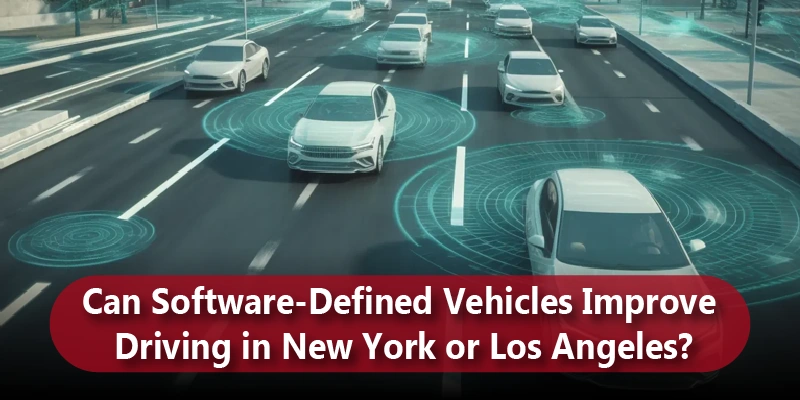
In short, yes, software-defined vehicles are poised to revolutionize urban transit by using AI-driven systems to slash congestion, improve safety, and provide real-time updates that hardware-based cars simply can’t match.
As of 2026, the contrast between the bumper-to-bumper gridlock of the future of driving in the USA and the potential of software-defined vehicles has never been sharper. In high-density hubs like New York City and Los Angeles, traditional driving is reaching a breaking point. However, smart vehicles in New York and Los Angeles are now hitting the pavement, using digital vehicle systems to transform traditional automobiles into connected, computer-driven machines. To maximize your vehicle’s performance in high-traffic cities, always ensure your Proactive Route Optimization setting is toggled to ON in your car’s digital menu, which allows the software to dodge gridlock before you even see it.
What Exactly is a Software-Defined Vehicle?
A software-defined vehicle is an automobile whose features and functions are primarily enabled through software, allowing it to evolve and improve over time via over-the-air updates. Unlike traditional cars that are defined by their hardware, such as the engine and the transmission, vehicle software technology allows these cars to learn new tricks like better fuel efficiency or enhanced autonomous vehicle features long after they leave the dealership.
Also check: Where to Charge Your EV in Los Angeles: Best Spots
How Do These Cars Tackle NYC’s Unique Chaos?
Driving in Manhattan isn’t just about speed; it’s about navigating a dense, unpredictable grid. Smart vehicles in New York are designed to integrate with the city’s expanding V2X Vehicle-to-Everything infrastructure.
Infrastructure Inputs and Urban Outcomes:
- Input: Real-time integration with NYC’s adaptive traffic signals.
Outcome: Reduction in stop-and-go idling, which currently accounts for a massive percentage of Manhattan’s emissions and brake wear. - Input: Implementation of digital vehicle systems that communicate with bridge and tunnel sensors.
Outcome: Automated rerouting to avoid box-truck bridge strikes and congestion-pricing zones during peak hours. - Input: Advanced pedestrian and cyclist detection via AI cars in the USA.
Outcome: A significant drop in urban accidents, supporting the city’s Vision Zero safety goals.
Can Smart Cars Solve the Infamous Los Angeles Gridlock?
In Los Angeles, the challenge is different: massive freeway spans and a culture of long commutes. Smart cars in Los Angeles leverage connected cars USA technology to treat the 405 freeway like a synchronized organism rather than a collection of isolated drivers.
Check out: Top 10 Affordable Cars for American Drivers With Real-World MPG in 2026
System Integration and Traffic Flow Results:
- Input: High-speed 5G connectivity between vehicles on the freeway.
Outcome: By synchronizing speeds and reducing gaps between vehicles, platooning can increase road capacity by up to 40% without expanding infrastructure. - Input: Dynamic autonomous vehicle features that handle stop-and-start traffic.
Outcome: Decreased driver fatigue and a reduction in rear-end fender benders caused by human distraction during slow-moving crawls. - Input: Urban driving technology that monitors air quality and optimizes EV battery thermal management.
Outcome: Lower localized smog levels during peak commuting windows and an extended range for electric fleets.
What Are the Key Benefits of This Shift?
Transitioning to software-defined cars USA offers more than just faster commutes. It represents a fundamental shift in how we maintain and value our transport.
- Continuous Improvement: Your car gets better with age through OTA updates, much like a smartphone.
- Predictive Maintenance: Digital vehicle systems can predict a part failure before it happens, preventing a breakdown on the Brooklyn Bridge.
- Enhanced Safety: AI cars in the USA use machine learning to identify hazards faster than a human eye can blink.
- Personalization: Settings like seat position, climate, and even driving feel are tied to a digital profile that follows you from car to car.
Common Pitfalls Drivers Experience with SDVs
- Ignoring Software Updates: Treating a car update like a phone update, skipping it can leave your vehicle vulnerable to security risks or missing out on safety patches.
- Over-Reliance on Features: Thinking autonomous vehicle features mean you can take a nap. Currently, most systems are driver-assist, not driver-replacement.
- Data Privacy Neglect: Not reviewing the data-sharing permissions in your car’s urban driving technology settings can lead to your driving habits being sold to insurance companies.
- Subscription Fatigue: Drivers often fail to realize that certain features in software-defined cars, such as heated seats or performance boosts, may require a monthly fee to remain active.
- The Ghost in the Machine Bug: New software can occasionally introduce bugs that cause screen flickers or sensor glitches, which require a digital reboot rather than a mechanical fix.
Expert Insight: The software-defined vehicle is essentially a smartphone on wheels. In five years, we won’t ask what a car’s horsepower is; we’ll ask about its processing power and its ability to talk to the city.
Frequently Asked Questions
Actually, they can be cheaper. Because of digital vehicle systems, many repairs or feature additions are handled via software updates, saving you a trip to the mechanic. Predictive maintenance also prevents costly, catastrophic failures.
Yes. While connected cars in the USA perform best with high-speed data, their core vehicle software technology is local to the car. They can still navigate and use safety features offline, though real-time traffic updates may lag.
Security is a top priority for manufacturers. Software-defined cars in the USA use end-to-end encryption and “zonal” architecture, meaning the entertainment system is digitally walled off from critical systems like braking and steering.
The primary hurdle isn’t the car, it’s the infrastructure. For urban driving technology to work perfectly, cities need to upgrade stoplights and road sensors to talk to the vehicles.
In the future of driving USA, we will see Level 4 autonomy in specific zones like downtown LA or Manhattan. However, for the foreseeable future, a human presence is likely required for complex urban maneuvers.
Key Takeaways
- Software-defined vehicles represent the shift from mechanical to digital-first automotive design, ensuring the car remains current for years.
- In New York, SDVs reduce congestion through signal synchronization and V2X communication, directly lowering CO2 emissions.
- In Los Angeles, connected cars USA increase freeway capacity through platooning and AI traffic management, reducing the 405 freeway’s bottleneck effect.
- Safety is the biggest winner, with AI cars USA providing a 360-degree safety net that humans lack, though drivers must remain alert.
- Infrastructure Dependence: The effectiveness of smart vehicles. New York relies heavily on local government investment in smart-city sensors.
- Value Retention: Unlike traditional cars that depreciate rapidly, SDVs hold value better because their tech features stay modern through the cloud.
Join the conversation at Ask about cars and explore expert advice, car tips, and the latest auto trends.
To submit the guest blog with us contact now.