


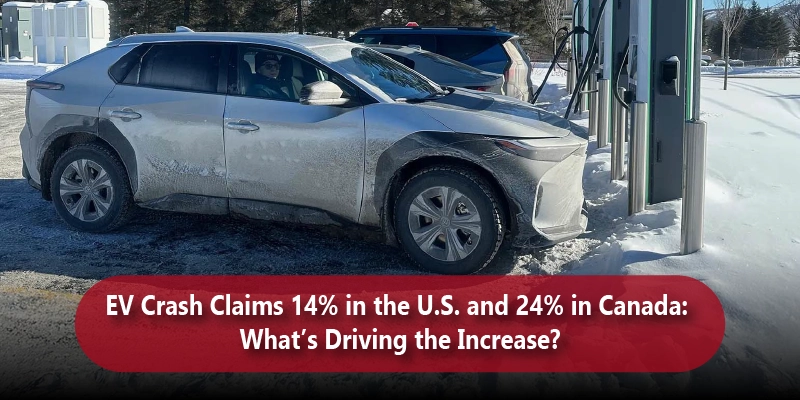
EV crash claims are rising due to higher EV volume on roads, aging fleets, complex sensor systems, and regional driving factors.

Why Are EV Insurance Claims Increasing in 2026?
The surge in electric vehicle collision claims across North America is not driven by declining safety standards, and it’s driven by fleet maturity and scale.
According to the 2026 Mitchell Plugged-In Industry Report, battery electric vehicles now represent:
- 3.07% of all U.S. repairable auto claims
- 4.77% of all Canadian repairable claims
That reflects:
- 14.1% year-over-year increase in the U.S.
- 24% year-over-year increase in Canada
Even though new EV sales growth cooled in 2025, the total number of car vehicles in operationreached critical mass. As more EVs age beyond their low-mileage honeymoon phase, exposure to real-world collision risk increases.
Primary Drivers Behind Rising Electric Vehicle Accident Rates in the U.S.
1. Fleet Maturity
More EVs are now beyond their early ownership period and are exposed to:
- Urban commuting
- High-density traffic
- Daily mileage accumulation
2. Instant Torque & Urban Driving
Electric motors deliver immediate torque. For new adopters, this often results in:
- Low-speed rear-end impacts
- Parking lot collisions
- Misjudged acceleration in stop-and-go traffic
3. Geographic Concentration
EV claims are heavily clustered in adoption hubs like California, where BEVs account for 6.5% of all repairable claims in early 2026.
Also Read: Crash-Tested: How These Electric Cars Fared in U.S. NCAP Safety Ratings
Why Are EV Collision Claims Rising Faster in Canada?
Canada’s 24% spike surpasses the U.S. trend for three structural reasons:
Regional Density
In provinces like:
- British Columbia
- Quebec
EVs represent over 8.3% of all repairable claims, significantly lifting the national average.
Winter Driving Dynamics
EVs are often:
- 20-30% heavier than comparable ICE vehicles
- Equipped with floor-mounted batteries, affecting weight distribution
On icy roads, braking distance and handling variability contribute to more recorded incidents.
Repair Network Bottlenecks
Rapid adoption in urban Canadian markets has outpaced:
- Certified EV repair infrastructure
- Specialized calibration capacity
This increases formally documented repairable claims instead of minor off-book fixes.
EV Repair Cost Trends in 2026
Interestingly, while claim frequency is rising, average repair severity declined slightly in 2026.
EV Repair Data Comparison (2026)
| Metric | U.S. | Canada |
| Average Claim Severity | $6,395 (5%) | $6,954 CAD (2%) |
| Calibrations per Estimate | 1.70 | 1.70 |
| OEM Parts Usage | 86% | 86% |
| Total Loss Value Decline | 6.44% | 12.62% |
Technical Complexity: The Real Cost Multiplier
Root Factor:
EVs feature dense electrical architecture and sensor-heavy systems.
Operational Consequence:
- 1.70 calibrations per estimate vs. 1.54 for gas vehicles
- Higher labor intensity
- Specialized diagnostic tooling required
Additionally, 86% of repair spend goes toward OEM components, as aftermarket alternatives remain limited for safety-critical systems.
Also Read: Why EV Charging in California is a Total Nightmare
EV Insurance Market Trends in 2026
The EV insurance landscape is shifting toward actuarial precision.
Telematics Adoption
Many insurers now:
- Require driving behavior tracking
- Offer premium discounts for monitored driving
Faster Total Loss Thresholds
Because EV resale values are declining faster than ICE vehicles, up to 12.6% in Canada, insurers are:
- Declaring total losses sooner
- Adjusting underwriting models
Battery-Specific Coverage
New endorsements now address:
- Battery degradation risk
- High-voltage system replacement exposure
EV Safety Data: Are Electric Cars Less Safe?
No. According to the National Highway Traffic Safety Administration, top-selling EVs continue to receive strong crash-test ratings.
Safety Strengths
- Low center of gravity reduces rollover risk
- Reinforced battery enclosures improve structural rigidity
External Risk Consideration
Heavier electric SUVs, some exceeding 9,000 lbs, increase the severity risk for the opposing vehicle in collisions.
The rise in claims reflects volume and complexity, not structural weakness.
Common Mistakes New EV Owners Make
- Over-reliance on regenerative braking in emergency stops
- Using non-certified repair shops
- Ignoring battery health alerts
- Underestimating torque delivery
EV Claims & Repair Trend Comparison (2026)
| Metric | U.S. | Canada | Canada vs U.S. % Difference |
| YoY Claims Increase | 14.1% | 24% | +9.9% |
| BEV Share of Repairable Claims | 3.07% | 4.77% | +1.70% |
| Average Claim Severity | $6,395 | $6,954 CAD | +8.7% |
| Depreciation Rate | 6.44% | 12.62% | +6.18% |
| Calibrations per Repair | 1.70 | 1.70 | 0% |
| OEM Parts Usage | 86% | 86% | 0% |
Frequently Asked Questions
Why is there a significant increase in EV crash claims in 2026?
Because the total number of EVs on the road has grown substantially, increasing overall accident exposure.
Are EV repair costs higher than those of gas cars?
Yes, due to heavy OEM part reliance and higher calibration requirements.
Why is Canada seeing a bigger surge than the U.S.?
Higher regional EV density and winter driving conditions contribute to increased claims.
Will EV insurance premiums rise?
Most likely, as insurers adjust for repair complexity and faster depreciation.
Does EV accident data 2026 show EVs are unsafe?
No, occupant safety remains strong; the rise is tied to fleet scale and repair complexity.
Market Leader Impact
Tesla continues to dominate claims volume, with:
- Tesla Model Y
- Tesla Model 3
Together, accounting for over 50% of BEV-related claims due to sheer market share.
Key Takeaways
- EV collision claims rose 14% in the U.S. and 24% in Canada
- EVs require 1.70 calibrations per repair estimate
- 86% of EV repair spend goes toward OEM parts
- Faster depreciation increases total-loss frequency
- Claims growth is driven by fleet scale, not declining safety
Get More Updated Automotive Insights at AskAboutcars!
For More Car-Related Blogs:
Crash-Tested: How These Electric Cars Fared in U.S. NCAP Safety Ratings
Why EV Charging in California is a Total Nightmare
EVs vs ICE Cars: Market Trends Across India and the US
For advertising, sponsored content, or brand collaboration opportunities on this platform, please visit: https://askaboutcars.com/advertise/


