


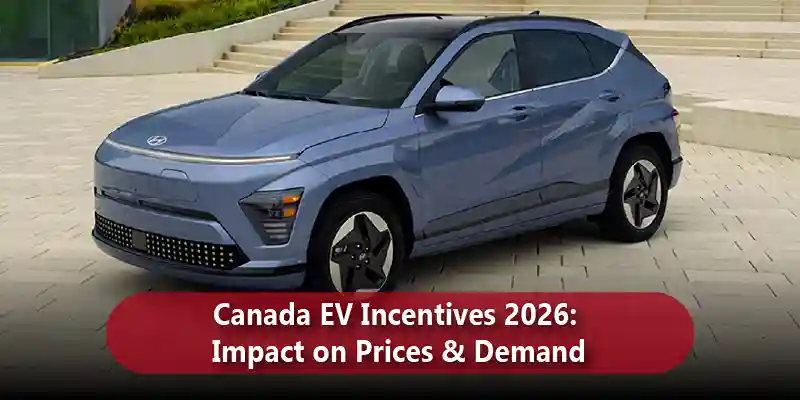
Canada’s electric vehicle market is entering a pivotal moment. In 2026, affordability not mandates is taking center stage, reshaping how and when Canadians make the switch to electric. With the federal government rolling out the $2.3 billion EV Affordability Program starting February 16, eligible buyers can access incentives of up to $5,000, dramatically lowering the upfront cost of EV ownership. This shift toward direct subsidies is designed to steady demand, improve access, and influence EV pricing and availability across key provinces such as Ontario, British Columbia, and Quebec making 2026 a year Canadian car buyers can’t afford to ignore.

What are the Canada EV incentives 2026?
The federal government has officially reintroduced a tiered rebate system under the EV Affordability Program. This program is designed to provide immediate relief at the point of sale.
The structure of the Canada EV incentives 2026 is as follows:
- $5,000 for new Battery Electric Vehicles and Hydrogen Fuel Cell Vehicles.
- $2,500 for Plug-in Hybrid Electric Vehicles.
These amounts are at their peak in 2026. To encourage early adoption, the government has scheduled a tapering effect where the rebate drops by $1,000 annually starting in 2027. If you wait until 2030, that $5,000 incentive will have shrunk to just $2,000.
Also Read: Canadian Road Trip Cars: Best Picks for 2026
How do these subsidies impact EV pricing Canada?
The primary goal of these electric vehicle subsidies is to bring the out-the-door price of an EV closer to that of a traditional internal combustion engine vehicle. However, the 2026 rules have introduced a strict price cap that creates a cause-and-effect dynamic in the market:
The $50,000 Final Transaction Price Cap
- Effect: Automakers are aggressively slashing MSRPs or introducing Lite trims to keep the final price before taxes under the $50,000 threshold.
- Effect: Luxury EVs and many popular Tesla trims that exceed this cap are seeing a temporary dip in demand as buyers pivot toward eligible models.
- Effect: Canadian-made EVs, like the Chrysler Pacifica Hybrid, are exempt from this cap, giving domestic manufacturing a massive competitive edge in EV pricing in Canada.
What are the current EV demand trends for 2026?
After a volatile 2025 where sales dipped due to the expiration of previous funds, EV demand trends are skyrocketing again. Market analysts predict that over 840,000 vehicles will be incentivized over the next five years.
Key Drivers of Demand:
- Stackable Savings: In provinces like Quebec and British Columbia, federal government EV incentives can be combined with provincial rebates, potentially shaving up to $9,000 to $12,000 off the total price.
- Infrastructure Expansion: The government’s concurrent $1.5 billion investment in charging infrastructure is finally easing range anxiety, making EVs a viable choice for rural Canadians.
- Limited Chinese Imports: A new trade agreement allows roughly 49,000 low-cost Chinese EVs into the market with reduced tariffs. While these don’t qualify for the $5,000 rebate, their lower base price is driving a new segment of budget-conscious buyers.
Also Read: How Canadian Drivers Can Cut Fuel and Maintenance Costs This Year
Key Benefits of the 2026 EV Strategy
- Immediate Savings: Receive up to $5,000 off at the dealership and no waiting for tax season.
- Lower Operating Costs: With fuel prices remaining volatile, the cost-per-km for EVs remains 60-70% lower than gas alternatives.
- Resale Value Protection: As Canada moves toward a 75% EV sales target by 2035, gas vehicles may face steeper depreciation, whereas incentivized EVs hold their value.
- Home Charging Rebates: Many provinces still offer up to $600-$1,500 for Level 2 home station installations.
Common Mistakes to Avoid When Buying an EV in 2026
- Ignoring the Final Transaction Rule: Remember, the $50,000 cap includes freight, PDI, and options. If your extras push you to $50,001, you lose the entire $5,000 rebate.
- Buying Non-FTA Vehicles: Only cars manufactured in countries with a Free Trade Agreement with Canada qualify. This currently excludes many models produced in China.
- Waiting Until December: The program has a fixed budget of $2.3 billion. If demand outstrips supply like it did in 2025, the funds could dry up before the year ends.
- Not Checking Provincial Eligibility: Some provincial programs have lower income caps than the federal one. Always verify both.
Most Common Questions
Federal electric vehicle subsidies are generally reserved for new vehicles. However, certain provinces like Quebec and Yukon offer used EV rebates of up to $2,000. Always check your local provincial guidelines to see if you can double up.
It depends on the model. Because the 2026 EV pricing Canada cap is set at a final transaction value of $50,000, many Tesla Model 3 and Model Y trims currently exceed the limit. You must find a base trim that stays under $50,000 to qualify.
You still qualify! For a 48-month lease, you typically receive the full $5,000 incentive. Shorter leases usually receive a pro-rated amount of the government EV incentives.
Only Plug-in Hybrid Electric Vehicles are eligible for a $2,500 rebate. Traditional self-charging hybrids do not qualify for federal support in the electric car market Canada.
By scrapping the 20% sales mandate in favor of emissions standards, the government has shifted the pressure to automakers. This is expected to increase the variety of EV models available, as manufacturers must sell more ZEVs to offset their high-emission truck and SUV sales.
Key Takeaways
- Act Fast for Maximum Savings: The Canada EV incentives 2026 are at their peak value of $5,000 for BEVs and $2,500 for PHEVs this year. These amounts are scheduled to taper down annually, dropping by $1,000 every year until 2030.
- The $50,000 Price Wall: To qualify for electric vehicle subsidies, the final transaction price of most vehicles must stay under $50,000. This includes all dealer fees and options, making base trims the most strategic choice for budget-conscious buyers.
- Canadian-Made Advantage: If you are looking for a more premium or larger vehicle, government EV incentives have no price cap on EVs manufactured within Canada. This makes domestic models like the Chrysler Pacifica Hybrid or Canadian-assembled Ford EVs significantly more competitive in EV pricing in Canada.
- FCEVs are included: For the first time, Hydrogen Fuel Cell Electric Vehicles are eligible for the full $5,000 rebate, signaling a broader government commitment to various zero-emission technologies.
- Monitor the Budget: The $2.3 billion EVAP fund is finite. History has shown that when the electric car market in Canada demand surges, these funds can be depleted before the fiscal year ends, and early birds definitely get the worm here.
Join the conversation at Ask about cars for the latest hacks and community tips on snagging the best EV deals in Canada.
For More Car-Related Blogs:
Winter Car Prep Checklist for Canadian Roads — Don’t Drive Without This
Have insights or experiences to share? Submit your blog through the link below and become part of our automotive community: https://askaboutcars.com/submit-blog/


