


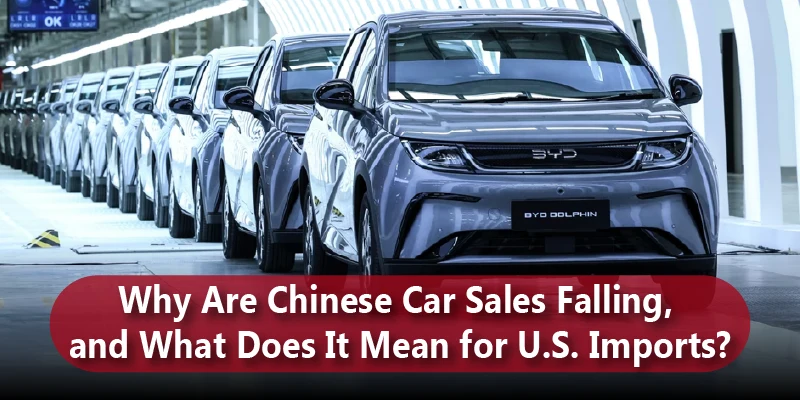
In short, Chinese car sales in the U.S. have recently lost momentum, and the reasons go far beyond simple market fluctuations. Lately, Chinese car sales in the U.S. have started to slow, and it’s not just because of shifting market trends. Sky-high 100% tariffs, the end of consumer tax credits that once boosted demand, and tighter rules back in China have all changed the landscape making it much harder for affordable models to reach American buyers.

As we move into early 2026, the once-feared flood of affordable vehicles from the East has hit a massive geopolitical and economic wall. While manufacturers like BYD and MG Motor initially eyed the North American market for massive expansion, a combination of protectionist trade policies and shifting domestic demand has turned 2026 into a year of retreat rather than conquest.
Why are Chinese EV sales dropping in the US?
The primary reason for the drop in sales is the Great Tariff Wall. Throughout 2025 and 2026, the U.S. moved to impose 100% tariffs on electric vehicles built in China. the U.S. effectively erased the low-cost advantage that was supposed to make these cars a future mainstay for American buyers.
Additionally, the Chinese car market crash usa experts predicted didn’t happen because of a lack of interest, but because of a lack of access. Most Chinese EVs no longer qualify for federal tax incentives, making them significantly more expensive than locally manufactured competitors like Tesla or Ford.
Root Causes and Subsequent Market Impacts:
- 100% Import Tariffs: Causes immediate price doubling, which affects a total loss of budget-friendly status for brands like BYD.
- Infrastructure Barriers: A lack of established dealership networks and parts availability causes consumer anxiety, resulting in lower volume for Chinese auto imports usa 2026.
- Regulatory Scrutiny: Increased U.S. Department of Commerce investigations into connected vehicle data privacy cause corporate delays, affecting a slower rollout of new models.
Also check: Is China’s Car Sales Slowdown Affecting EV Availability in Dubai?
What is behind the BYD sales decline in the USA?
The BYD sales usa decline is particularly shocking given the company’s global dominance. At the opening of 2026, BYD’s overseas sales growth took a hit, declining 30% compared to last years. The company has shifted its strategy away from direct U.S. passenger car imports, focusing instead on manufacturing hubs in Mexico and Brazil to bypass direct trade barriers.
Key Challenges for BYD:
- Brand Perception: Difficulty in moving from a low-cost brand to a premium EV competitor.
- Software Bans: Potential U.S. bans on Chinese-origin driving software have frozen many product launches.
- Local Competition: U.S. legacy automakers have ramped up production of affordable hybrids, stealing BYD’s thunder.
Check out: Charging an EV in China: How Easy Is It Really?
Why are MG Motor and Great Wall Motors struggling?
Both MG Motor sales drop usa and Great Wall Motors USA sales reflect a broader trend of export cooling. For MG, the issue has been the price hike; as they improved safety and quality to meet Western standards, their price advantage vanished. For Great Wall Motors, the struggle lies in the highly competitive Chinese SUV sales usa 2026 segment, where American buyers still prefer established domestic or Japanese brands for long-term reliability.
The Impact on American Imports:
- Market Fragmentation: Dealers are more hesitant to take on new Chinese franchises due to political volatility.
- Supply Chain Pivot: Importers are looking toward South Korea and Vietnam as alternative sources for affordable vehicles.
- Price Inflation: With less pressure from ultra-cheap Chinese models, the average transaction price for U.S. cars remains high, near $50,000.
Key Benefits of the Current Market Shift
- Domestic Growth: Provides a breathing room for U.S. EV startups to scale without being undercut.
- Data Security: Reduces the risk of foreign software being integrated into critical national infrastructure.
- Labor Protection: Ensures that the transition to green energy supports American manufacturing jobs.
Common Mistakes When Buying Imports
- Ignoring Serviceability: Buying a niche import without checking if there is a local mechanic who can service the battery or software.
- Overlooking Resale Value: Chinese cars failing in America often suffer from massive depreciation due to brand uncertainty.
- Assuming Tax Credits: Many buyers assume all EVs get the $7,500 credit where most Chinese imports currently get $0.
Expert Insight: The 2026 slowdown isn’t a failure of technology; it’s a victory for protectionism. Chinese automakers are producing some of their best cars yet, but crushing tariffs are blocking them from becoming real options for American shoppers.
Frequently Asked Questions
Currently, very few. Most cheap models are blocked by tariffs. You are more likely to see Chinese-owned brands like Volvo or Polestar that manufacture in third-party countries.
The twin pressures of steep tariffs and China’s zero-kilometer export rule have effectively shut down the export of excess vehicles to foreign markets as used chinese cars.
Probably, if trade relations thaw or brands open U.S.-based factories, we could see a massive resurgence.
They were slashed by nearly 60% after the latest round of trade restrictions and the withdrawal of several Great Wall Motor models from the homologation process.
No, BYD is pivoting to commercial vehicles and energy storage, where the barriers are slightly different than the passenger car market.
Key Takeaways
- Tariff Stagnation: The Chinese car sales decline usa is primarily a result of the 100% tariff wall and the 2026 USMCA review, which closed loopholes for Mexico-based assembly.
- Pivot to Hybrid: Brands like BYD are seeing a decline because the U.S. market has shifted heavily toward Hybrids, a segment where domestic brands currently hold the infrastructure advantage.
- Homologation Hurdles: Many Chinese auto imports usa 2026 failed to launch because they could not meet the new, stricter U.S. Department of Transportation safety and software connectivity standards.
- Used Car Loophole Closed: New 2026 regulations in China have effectively stopped the practice of exporting new cars as used to bypass certain U.S. trade barriers.
- The Wait and See Consumer: The impact of Chinese cars on American imports has led to consumer decision paralysis, where buyers are waiting for trade wars to settle before committing to an import brand.
For any kind of car maintenance tips, tricks, and suggestions, join the conversation at Ask About Cars.
To advertise with us contact us now!


