


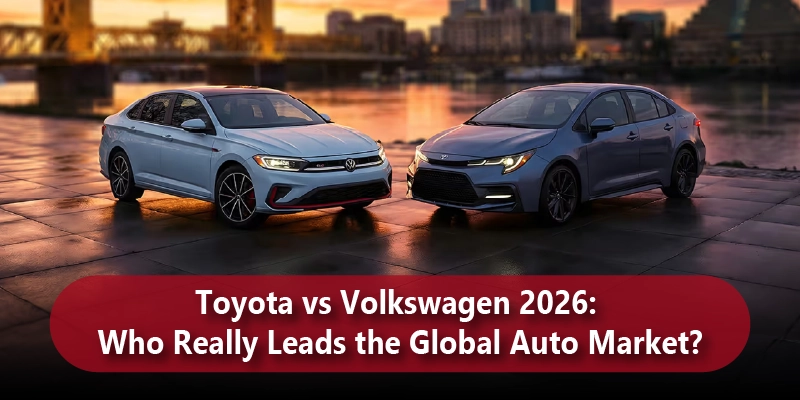
Toyota leads global sales in 2026, while Volkswagen dominates European EV growth and premium innovation.

Is the Toyota vs Volkswagen 2026 just about sales numbers? Or does leadership now depend on EV strategy, reliability, and long-term profitability?
In 2026, the global automotive industry is defined by electrification mandates, hybrid transitions, AI-driven features, and evolving consumer demand across Asia, Europe, North America, and the Middle East. The battle between Toyota Motor Corporation and Volkswagen Group is no longer about who sells more cars; it’s about who owns the future.
Does Toyota Still Lead Global Sales in 2026?
Yes, Toyota maintains a narrow but consistent global volume lead. The Main Reasons includes:
- Hybrid dominance across global markets
- Strong SUV lineup, such as RAV4, Corolla Cross, Land Cruiser
- Wider presence in emerging economies
Market Expansion
- A hybrid-first strategy leads to Less dependency on the charging infrastructure
- Cost-efficient production with Competitive global pricing
- Proven reliability reputation with Higher repeat buyers
In the Toyota Volkswagen sales comparison 2026, Toyota wins in total units sold globally.
Related insights: Texas Road Test: 2026 Toyota RAV4 Review — How It Handles Lone Star Roads
Who Has the Bigger Market Share in 2026?
Market share depends on the region.
Volkswagen Strength
- Strong dominance in Europe
- Aggressive EV penetration
- Premium sub-brand leverage like Audi and Porsche SUVs
Toyota Strength
- Asia-Pacific leadership
- North American SUV performance
- Middle East and Africa expansion
Stronger EV Positioning
- EU EV policies boost Volkswagen EV demand
- Hybrid adoption in developing regions boosts Toyota sales
In the volkswagen vs toyota market share debate, VW wins Europe; Toyota wins globally.
Toyota vs Volkswagen Comparison 2026
| Category | Toyota 2026 | Volkswagen 2026 |
| Global Sales Volume | Higher total units | Slightly lower |
| European Market Share | Moderate | Strong dominance |
| EV Portfolio | Growing bZ series | Extensive ID lineup |
| Hybrid Technology | Industry leader | Limited focus |
| Reliability Perception | Very high | Moderate |
| Premium Appeal | Practical & durable | Tech-forward & refined |
| Long-Term Ownership Cost | Lower | Slightly higher |
This Toyota vs Volkswagen comparison 2026 highlights strategic differences rather than a clear universal winner.
Which Brand Is More Reliable in 2026?
In the Toyota vs VW reliability 2026, Toyota remains ahead.
Why Toyota Scores Higher:
- Two decades of hybrid refinement
- Lower mechanical complexity
- Fewer software-related recalls
Why VW Faces Challenges:
- Tech-heavy systems
- Rapid EV platform expansion
- Software integration learning curve
Premium Positioning
- Conservative engineering leads to Long-term durability
- Advanced digital architecture with occasional software recalls
If reliability is your top priority, Toyota leads.
Who Wins the EV Battle in 2026?
The Toyota vs Volkswagen EV comparison 2026 favors Volkswagen in pure EV volume.
Volkswagen EV Edge
- Large-scale ID series production
- European charging ecosystem alignment
- Dedicated EV platforms
Toyota EV Approach
- Gradual EV rollout
- Continued hybrid dominance
- Heavy investment in solid-state battery research
Emission Regulations on EV Expansion
- Early EV commitment leads VW to be stronger in Europe
- The hybrid strategy insists that Toyota lowers risk exposure
- Solid-state R&D gives Potential long-term Toyota advantage
Toyota vs VW 2026 Models: Which Lineup Is Stronger?
The Toyota vs VW 2026 models comparison shows different priorities.
Toyota Focus
- Efficiency
- Reliability
- SUV scalability
Volkswagen Focus
- Electrification
- Premium interiors
- Performance-driven variants
When asking Toyota vs volkswagen which is better, the answer depends on whether you value reliability or advanced EV tech.
Which Is Better, Toyota or Volkswagen 2026?
There is no universal winner.
Choose Toyota if you want:
- Lower ownership costs
- Proven durability
- Strong resale value
Choose Volkswagen if you want:
- EV leadership
- Premium interiors
- European engineering feels
That’s the real answer to which is better toyota or volkswagen 2026.
Comparison based on Performance
Below is a comparison of performance that shows the differences between Toyota and Volkswagen based on critical indicators for businesses and owners in 2026. It includes global sales volume, regional market share, sales of EV and hybrid vehicles, reliability scores, ownership cost index, and strength in the SUV segment. The performance comparison below makes it clear why Toyota is a leader in long-term ownership value and hybrid-adoption, while Volkswagen performs better in terms of European market share and electric vehicle sales respectively.

Common Buyer Mistakes in Toyota vs Volkswagen 2026 Decisions
- Choosing brand prestige over long-term cost
- Ignoring the charging infrastructure availability
- Comparing different trim levels unfairly
- Overlooking resale value differences
These mistakes often impact ownership satisfaction more than brand choice itself.
Everything You Need to Know
Toyota leads global total sales volume.
Volkswagen leads in full EV sales; Toyota leads in hybrids.
Toyota ranks higher in long-term reliability studies.
Toyota leads globally; Volkswagen dominates Europe.
Toyota for durability; Volkswagen for EV innovation.
Key Takeaways
- Toyota leads global volume and reliability perception
- Volkswagen leads European EV transformation
- Hybrid vs full EV strategy defines the 2026 competition
- Market leadership varies by geography
Toyota wins globally in sales and reliability. Volkswagen wins in EV aggression and European dominance.
Get New Automotive insights at Ask About Cars!
For advertising, sponsored content, or brand collaboration opportunities on this platform, please visit: Advertise with us


