

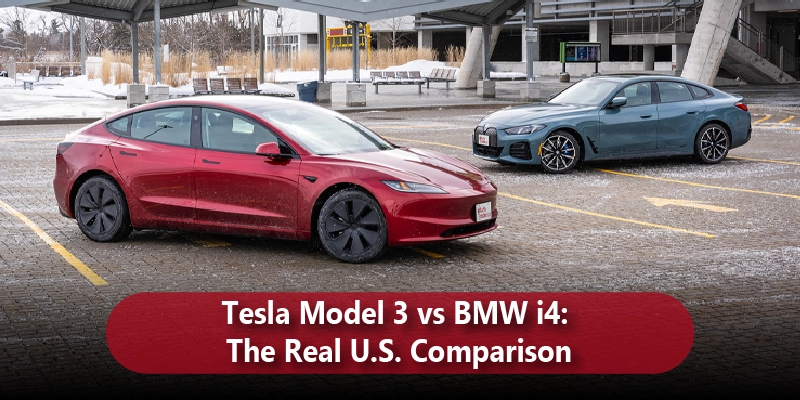
Tesla Model 3 offers better value, tech, and charging; BMW i4 delivers superior luxury, ride comfort, and traditional driving feel.

The 2026 US EV Market: Tech vs Traditional Luxury
As the American EV market matures in 2026, buyers choosing between the Tesla Model 3 and BMW i4 are no longer just comparing specs and they’re choosing between two philosophies:
- Silicon Valley software dominance
- Bavarian mechanical refinement
Tesla refined the Model 3 with its Highland update, while BMW improved efficiency and software integration in the i4 lineup. The result? A sharper, more competitive battle than ever.
On-Road Performance: Acceleration, Stability & Driving Feel
Acceleration
- Model 3 Performance: 0-60 mph in 2.9 seconds
- i4 M60: 536 hp, slightly slower sprint but more composed at high speeds
Tesla delivers explosive instant torque. BMW delivers controlled, planted acceleration that feels more refined at highway speeds.
Driving Dynamics
- Tesla feels lighter and more digital.
- BMW feels heavier, more grounded, and traditionally driver-focused.
If you prefer a sharp throttle response, choose Tesla for smooth performance
If you prefer stability and chassis balance, choose BMW for a good, balanced drive.
Also Read: Tesla Model Y vs Hyundai Ioniq 5: Best EV for UK Drivers?
Ownership Cost & Incentive Landscape in 2026
When evaluating long-term ownership economics, the gap between the Tesla Model 3 and BMW i4 becomes structurally clear.
MSRP Positioning
- Tesla Model 3: Positioned in the upper-mainstream EV bracket, typically ranging from the high-$30K range into the mid-$50K range depending on trim.
- BMW i4: Firmly in the premium segment, with entry pricing in the high-$50K range and well into the $70K+ zone when configured with M Performance packages and luxury options.
Federal Incentive Impact
Many Model 3 configurations qualify for the $7,500 Federal Clean Vehicle Tax Credit, subject to battery sourcing and income eligibility rules. This can materially lower the effective purchase price.
The BMW i4, due to assembly and sourcing classifications, often does not qualify for the full purchase credit. However, buyers may access incentives through lease structures where the credit is applied at the financing level and passed through as a lease incentive.
Cost Structure Analysis
- Effective Purchase Price Advantage: Tesla
- Luxury Equipment & Customization Depth: BMW
- Lower Cost per Mile: Tesla
- Higher Brand Prestige & Traditional Premium Positioning: BMW
Charging Speed & Infrastructure
| Category | Tesla Model 3 | BMW i4 |
| Peak DC Charging | 250 kW | 200 kW |
| 15-Minute Add | ~175 miles | ~140–160 miles |
| Charging Network | Supercharger (NACS) | Electrify America + NACS access |
| Plug & Charge | Seamless | Varies by network |
Tesla’s charging ecosystem remains its biggest competitive advantage in the US. BMW i4 models now support NACS or official adapters, reducing infrastructure concerns.
Interior & Practicality
Tesla Model 3
- Minimalist interior
- Central touchscreen only
- More headroom
- Frunk and deep trunk storage
BMW i4
- Traditional instrument cluster
- Physical climate buttons
- Higher material quality
- Hatchback practicality
The i4’s hatchback design makes it easier to load bikes and bulky cargo, which is a commonly overlooked advantage.
Range Impact: What Actually Affects Real-World Mileage?
Real-world EV range is heavily influenced by driving conditions and configuration choices. Larger 20-inch wheels increase rolling resistance and aerodynamic drag, which typically reduces total range by 10-15%. Cold winter temperatures slow lithium-ion battery chemistry, leading to noticeable range drops of 15–25%, although Tesla’s integrated heat pump system helps moderate efficiency loss during colder months.
Aggressive acceleration and sustained high-speed driving demand higher energy discharge, which rapidly drains the battery in both the Tesla Model 3 and BMW i4. Conversely, proper battery preconditioning before arriving at a DC fast charger improves charging efficiency and can significantly reduce total charging time.
Common Buyer Mistakes to Avoid
- Buying Tesla FSD expecting full autonomy.
- Ignoring BMW’s hatchback cargo advantage.
- Skipping test drives as the interior philosophy feels radically different.
- Choosing large wheels without considering the range impact.
- Forgetting to precondition the battery before DC fast charging.
Also Read: BMW 2026 Recall Explained: Fire Risk, Affected Models & What Owners Must Do Now
2026 Tesla Model 3 vs BMW i4
| Feature | Tesla Model 3 | BMW i4 |
| Starting Price | ~$39,000 | ~$58,000 |
| Max Range | 341 miles | 333 miles |
| 0-60 (Top Trim) | 2.9 sec | ~3.3 sec |
| Charging Peak | 250 kW | 200 kW |
| Interior Style | Minimalist Tech | Traditional Luxury |
| Cargo Layout | Sedan and Frunk | Hatchback |
| Tax Credit | Often Eligible | Lease-based eligibility |
Frequently Asked Questions
Tesla Model 3 historically holds value well but fluctuates with pricing changes.
BMW i4 feels more linear and refined; Tesla feels more aggressive.
Yes, most 2026 BMW i4 models support NACS or official adapters.
Model 3 offers more headroom; i4 feels slightly snug.
Tesla prioritizes tech and efficiency; BMW prioritizes luxury and driving feel.
Key Takeaways: Tesla Model 3 vs BMW i4 (2026)
- Best Overall Value: Tesla Model 3 has a lower starting price, stronger federal tax credit eligibility, and better efficiency per kWh.
- Best Luxury Experience: BMW i4 has higher material quality, quieter cabin, more traditional premium feel.
- Fastest Acceleration: Model 3 Performance
- More Refined Power Delivery: i4 M60 smoother, more planted at high speeds.
- Longest Range: Model 3 Long Range
- Better Charging Network: Tesla’s Supercharger reliability remains unmatched in the US.
- More Practical Cargo Design: BMW i4 hatchback layout offers easier large-item loading.
- Better for Tech-Focused Buyers: Tesla’s OTA updates, software ecosystem, minimalist UI.
- Better for Traditional Drivers: BMW has physical buttons, an instrument cluster, familiar cockpit layout.
- Lower Long-Term Running Costs: Tesla has stronger efficiency, along with wider charging access.
Get More Updated Automotive Insights at AskAbout Cars!
For More Car-Related Blogs:
How much does it cost to charge Tesla at home in the USA?
Have insights or experiences to share? Submit your blog through the link below and become part of our automotive community: https://askaboutcars.com/submit-blog/