


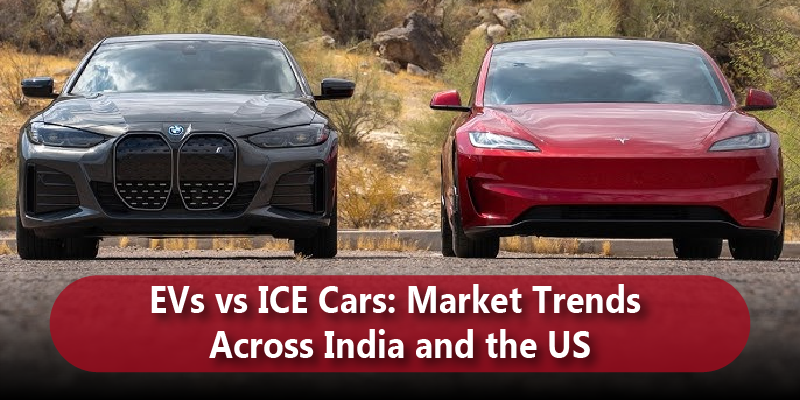
As of early 2026, the global automotive market has moved well beyond a simple EV-versus-ICE debate. Instead, clear regional strategies are emerging. India is witnessing a bottom-up electrification surge, driven by mass-market two-wheelers and increasingly affordable compact SUVs. In contrast, the United States is charting a more measured course, leaning into a hybrid-heavy transition that bridges conventional internal combustion engines and full electrification.

This divergence is reflected in adoption patterns. India recorded more than 2.3 million EV registrations in the past 12 months, signaling rapid grassroots momentum. Meanwhile, the US market is stabilizing its pure-EV growth as automakers such as Ford and GM expand hybrid offerings to address real-world concerns around range, cost, and infrastructure. Together, these trends illustrate how electrification is no longer one-size-fits-all but shaped by local economics, consumer behavior, and policy realities.
What are the Current EV Adoption Trends in India vs. America?
The year 2026 marks a definitive shift in how both nations approach decarbonization. India’s momentum is fueled by urban economics, while the US is navigating a complex transition involving infrastructure scaling and premium segment saturation.
India’s 2026 Landscape: The Era of Execution
In India, EVs vs petrol cars India comparisons are increasingly favoring electric models due to plummeting battery costs, which have reached a historic low of $60/kWh. This has allowed manufacturers like Tata and Mahindra to capture significant market share in the sub-₹20 lakh segment.
Strategic Drivers and Market Outcomes:
- Economic Stimulus: The implementation of GST 2.0 and state-level incentives has reduced the upfront price of electric hatchbacks.
- Consumer Shift: A significant migration toward petrol diesel vs electric cars is visible in urban centers, where operational costs are now approximately 75% lower for EVs.
- Manufacturing Localization: Massive investments in domestic cell production have stabilized the supply chain, reducing the import-dependency risk.
- Infrastructure Maturation: The rise of battery-swapping networks has made electric 3-wheelers the default choice for last-mile logistics.
Also Read: Chicago Auto Show 2026: All New Car Launches, EVs & Concepts You Can’t Miss
The US 2026 Landscape: The Pragmatic Pivot
The electric vs traditional cars US narrative is no longer about Tesla vs. Everyone. In 2026, the market is characterized by the widespread adoption of the North American Charging Standard and a surge in Plug-in Hybrid sales.
Strategic Drivers and Market Outcomes:
- Infrastructure Realism: While the NEVI program has expanded highway charging, rural range anxiety continues to drive consumers toward high-efficiency ICE and hybrid trucks.
- Inventory Diversification: Major US automakers have delayed some all-electric launches in favor of bridge technologies that offer 50+ miles of electric range alongside a petrol engine.
- Price Dynamics: Average EV transaction prices have dropped toward $45,000, narrowing the gap with ICE vs ev comparison 2026 benchmarks, yet financing rates remain a critical hurdle for mass adoption.
How Does the 2026 ICE vs. EV Comparison Look for the Average Buyer?
The decision-making process for car buyers in 2026 is now governed by Total Cost of Ownership and Utility Value rather than just environmental sentiment.
Key Benefits of EVs
- Exceptional Efficiency: EVs convert over 85% of electrical energy into motion, compared to just 20-30% for ICE vehicles.
- Simplified Maintenance: With approximately 90% fewer moving parts in the drivetrain, EVs eliminate oil changes, transmission repairs, and exhaust maintenance.
- Digital Integration: 2026 models feature advanced Software-Defined Vehicle architectures, allowing for significant performance upgrades via Over-the-Air updates.
- Instant Torque: The driving dynamics of EVs vs ICE cars favor the former for urban responsiveness and silent luxury.
Also Read: Mazda Delays EVs to 2029: Smart Move or Strategic Risk?
Key Benefits of ICE Cars
- Refueling Logistics: For long-haul logistics and rural travel, the 5-minute refuel time of petrol/diesel remains an unbeaten convenience.
- Lower Entry Barrier: Despite falling battery prices, entry-level ICE cars remain the most accessible path to mobility for the middle class.
- Established Resale Markets: The secondary market for ICE vehicles is more mature, providing more predictable depreciation curves than older-generation EVs.
What are the Dominant EV ICE Market Share Trends in 2026?
Data from the Vahan Dashboard and US sales forecasts reveal a clear trajectory for EV ICE market share in India and the US.
| Metric | India (2026 Forecast) | US (2026 Forecast) |
| EV Market Share | ~7.5% for Passenger / 20% (2W) | ~12% Pure BEV |
| Hybrid Share | ~5% Strong Hybrids | ~20% PHEV + HEV |
| Primary Segment | Affordable Compacts <$20k | Premium SUVs & Trucks |
| Dominant Player | Tata Motors 43% EV share | Tesla ~45% EV share |
Why is the Future of EVs vs ICE Cars a Multi-Path Journey?
The future of EVs vs ICE cars is evolving into a coexistence strategy. In India, the focus is on Saturation Programs in top-tier cities. In America, the focus is on Charging Reliability and NACS Integration to make the user experience as seamless as a petrol station visit.
Common Mistakes to Avoid in 2026
- Underestimating Home Charging: Relying solely on public fast-chargers is the most expensive and least convenient way to own an EV.
- Ignoring Battery Chemistry: Not all batteries are equal; LFP is better for longevity, while NMC is superior for cold-weather performance in the US.
- Overlooking Resale Value: Buyers often ignore the Battery Health Certificate, which is now a mandatory document for reselling an EV in 2026.
Key Takeaways
- India’s Growth is Bottom-Up: The ev market growth India US differs because India’s revolution is on two and three wheels, while the US is focused on heavy-duty passenger vehicles.
- Hybrids are the Middle Ground: In both regions, hybrids are seeing a resurgence as a risk-mitigation strategy against underdeveloped charging grids.
- Operational Economics Win: The primary reason for ev adoption trends India America shifting is no longer green ego but the undeniable 60-70% savings in monthly running costs.
- The $80/kWh Milestone: Battery prices hitting the double-digit mark in 2026 is the single biggest factor making EVs vs ICE cars market trends favor electrification.
- Software is the New Engine: Buyers are increasingly choosing cars based on their Connected Tech and Autopilot features, areas where EVs naturally lead.
- Infrastructure is the Great Equalizer: The success of the future of EVs vs ICE cars depends entirely on the speed of public charger installation on national highways.
Frequently Asked Questions
Yes, in many segments. With battery prices falling below $65/kWh, entry-level electric hatchbacks are expected to match the on-road price of premium petrol hatchbacks by late 2026, especially when factoring in the lower registration taxes for EVs.
Charging reliability and grid capacity. While many Americans have home charging, those in multi-unit apartments still face challenges, leading to a higher preference for hybrids that don’t require daily plugging.
Currently, ICE cars maintain a slight edge in resale value due to a more established used-car market. However, EVs with high-quality LFP batteries and documented Battery Health are quickly closing this gap as buyer confidence grows.
Luxury brands like BMW and Mercedes-Benz have seen EV sales contribute over 25% of their total volume in 2026. High-end buyers prioritize the silent performance and tech-first cabin experience that EVs provide over traditional engines.
Yes. In the US, the expansion of the Tesla Supercharger network to all brands has made long-distance EV travel much easier. In India, while highway charging is improving, ICE cars still offer more flexibility for remote, off-beat travel destinations.
Join the conversation at Ask about cars to get real-time advice on your next purchase.
For More Car-Related Blogs:
5 Affordable EVs to Consider Instead of a New Gas Car — Best Options for Chicago Shoppers
Have insights or experiences to share? Submit your blog through the link below and become part of our automotive community: https://askaboutcars.com/submit-blog/


