


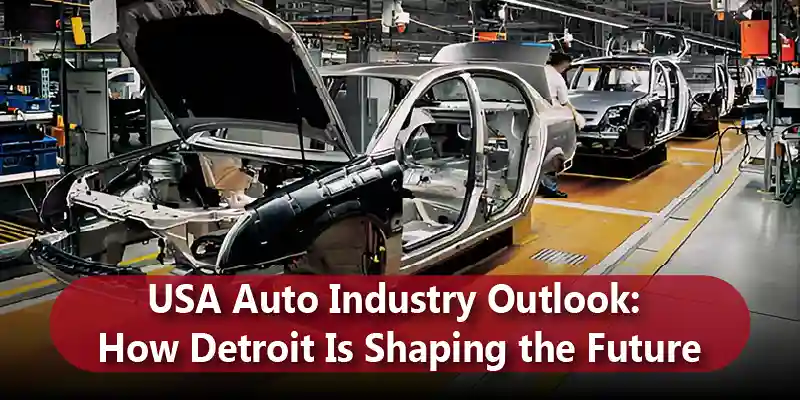
In short, the US auto industry outlook 2026 is characterized by a pragmatic reset, where Detroit shifts focus from aggressive all-electric targets to a balanced mix of hybrids and high-margin internal combustion engine vehicles. While new vehicle sales are projected to dip slightly to 15.8 million units, the industry is becoming more efficient through AI-driven manufacturing and nearshoring.

As we move through 2026, the US automotive market 2026 is grappling with the removal of federal EV tax credits and a new Darwinian era of competition. In Detroit, the historic heart of Detroit car manufacturing trends, the Big Three EVs, such as Ford, GM, and Stellantis, are recalibrating their assembly lines to meet a bifurcated consumer base: wealthy buyers demanding tech-heavy luxury and middle-class drivers searching for affordability.
How are Detroit EV production plans changing in 2026?
The future of the American car industry’s success currently hinges on flexibility. Unlike the EV-only promises of 2021, the Detroit EV production plans for 2026 have shifted toward a multi-energy strategy. Automakers are now utilizing modular platforms that can host gas, hybrid, or electric powertrains on the same line.
The Forces Driving the Next Phase of EV Adoption:
- Cause: Expiration of federal EV tax incentives and high interest rates.
Impact: A cooling of pure-EV demand, leading to a projected electric vehicle Detroit market share dip to roughly 6-8%. - Cause: Massive $19.5 billion charge-offs by giants like Ford.
Impact: Capital is being redirected toward hybrid trucks and SUVs, which offer the high margins needed to fund long-term R&D. - Cause: Breakthroughs in LFP battery chemistry.
Effect: The arrival of more affordable models, such as the 2026 Nissan Leaf and the redesigned Chevy Bolt, priced near $30,000.
Also Read: Why Is CES 2026 Shifting the Auto Industry from Cars to AI Technology?
What are the key US car manufacturing forecast trends?
According to the latest US car manufacturing forecast, the industry is moving away from just-in-time global sourcing toward a nearshoring model. Under USMCA rules, nearly 75% of vehicle components must be sourced within North America, driving a massive investment in domestic battery Gigafactories across the Midwest and the South.
Key Benefits of the 2026 Manufacturing Shift:
- Supply Chain Resilience: Reduced reliance on overseas semiconductors and rare earth minerals from volatile regions.
- AI Integration: Use of Digital Twins in the automotive industry trends USA to predict assembly line bottlenecks before they happen.
- Economic Stability: Maintaining high-wage manufacturing jobs in the Battery Belt, securing the Detroit Big 3’s future.
- Market Alignment: Faster response times to consumer shifts, such as the sudden 2025-2026 surge in hybrid demand.
What are the US auto sales predictions for the year?
The US auto sales predictions for 2026 suggest a market that is stabilizing rather than surging. Analysts anticipate a 2.4% decline in total volume compared to 2025, largely due to pre-tariff buying that occurred in late 2025.
Common Mistakes for Buyers & Investors in 2026:
- Ignoring Residual Value: Overlooking how the lack of incentives affects the resale value of 2026 EVs.
- Underestimating Hybrids: Assuming ICE is dead; in reality, hybrids are the bridge dominating the American auto industry news cycle this year.
- Waiting for Lower Prices: Expecting a massive price crash; while inventory has normalized, manufacturing costs remain elevated due to new labor contracts and material inflation.
Also Read: Is the Snow Storm Causing Major Travel Disruptions in the U.S.?
How is the Detroit Big EVs, hybrids, software, batteries future being secured?
To ensure the Detroit Big 3’s future, Ford, GM, and Stellantis are leaning into their cash cow segments, full-size pickups and SUVs. By integrating US car manufacturing forecast data with AI-driven logistics, they are protecting their margins while slowly scaling the electric vehicles Detroit infrastructure.
Strategic Moves in 2026:
- GM: Launching the Cadillac VISTIQ and high-volume Bolt EV to cover both ends of the price spectrum.
- Ford: Pivoting the Skunkworks team to develop a low-cost EV platform to compete with Chinese imports.
- Stellantis: Leveraging its STLA platforms to offer unmatched powertrain flexibility across Jeep and Ram brands.
Expert Insight: 2026 isn’t the death of the EV; it’s the birth of the affordable American EV. Detroit is finally stopping the chase for luxury-only electrics’ and building cars for the average commuter.
Frequently Asked Questions
The outlook is cautious but improving. While US auto sales predictions show slightly lower volume, the return of off-lease vehicles is providing a much-needed boost to the used car market, offering more affordable entry points.
Not entirely. While Detroit EV production plans remain a priority, there is a significant resurgence in internal combustion and hybrid technology to meet current consumer demand and maintain profitability.
Automakers are responding by lowering MSRPs and shifting to LFP batteries. The future of the American car industry’s growth now depends on price parity rather than government subsidies.
Software-defined vehicles. Beyond the engine, the ability for a car to receive over-the-air updates and offer subscription-based features is the newest revenue frontier for Detroit.
Yes, most analysts expect 2026 to be a plateau year, with a steady climb in production starting in 2027 as new battery plants reach full capacity.
Key Takeaways
Market Stability: New vehicle sales will hover around 15.8 million, reflecting a higher-for-longer pricing environment.
- Hybrid Heroics: Hybrids are the stars of the US automotive market in 2026, acting as the primary growth driver for the Big 3.
- Tech Overload: AI and software are now as critical to Detroit car manufacturing trends as steel and rubber.
- Affordability Focus: The Darwinian era is forcing manufacturers to release EVs priced under $30k to stay competitive.
Join the conversation at Ask about cars! What do you think about Detroit’s pivot to hybrids? Let us know in the comments!
For More Car-Related Blogs:
Top 7 US Cars With ADAS Features That Could Save Your Life in 2025