


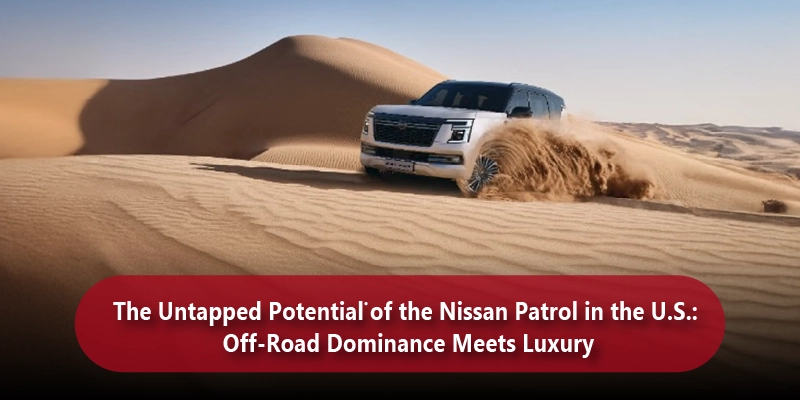
The Nissan Patrol delivers elite off-road capability and luxury, but in the US, it exists as the Armada, missing its full global performance edge.
The SUV in the US Market Is Only Partially Experiencing
The Nissan Patrol US off-road review is not simply about a vehicle that is missing from the American market and it is about a globally proven SUV whose full potential is not being experienced by US buyers. While American consumers technically interact with the Patrol’s underlying platform through the Nissan Armada, the true global Patrol stands in a completely different league when it comes to engineering intent, capability, and positioning.
In regions such as the Middle East and Australia, the Nissan Patrol has earned a reputation that goes far beyond that of a conventional SUV. It is widely regarded as a benchmark for durability, high-load performance, and extreme off-road resilience. Built to operate in some of the harshest environments on the planet, the Patrol is engineered to handle relentless desert heat, vast stretches of soft dunes, rocky escarpments, and long-distance expeditions where reliability is critical. In these markets, it is not just compared to the Toyota Land Cruiser as it often challenges or even surpasses it in areas such as high-speed desert stability, engine performance, and cabin space.
However, the experience in the United States tells a different story. The Nissan Armada, while sharing structural similarities, is calibrated with a distinct focus on:
- Everyday family usability
- Smooth on-road driving dynamics
- Comfort-oriented suspension tuning
- Broad mainstream appeal
This shift in focus means that key elements that define the Patrol globally such as specialized off-road tuning, advanced mechanical systems, and extreme-terrain readiness are either softened or absent altogether. As a result, there is a noticeable gap between the Patrol’s global identity as a rugged luxury powerhouse and the version of that experience currently available to US consumers.
As we move further into 2026, this gap is becoming more significant rather than less. Consumer behavior is evolving in response to changing market conditions, with buyers increasingly prioritizing long-term reliability, total cost of ownership, and real-world versatility over purely digital features or trend-driven innovations. There is a growing demand for vehicles that can seamlessly transition between daily commuting, family responsibilities, and demanding outdoor use cases such as towing, overlanding, and cross-state travel.
Why the Nissan Patrol vs Land Cruiser US Debate Is Heating Up Again
The rivalry between the Nissan Patrol and Toyota Land Cruiser has always been intense, but recent developments have reignited interest especially in the United States.
A Shift in Land Cruiser Strategy
Toyota’s latest Land Cruiser 250 Series has taken a different direction:
- Downsized footprint
- Hybrid-only powertrain
- Greater focus on fuel efficiency
While this appeals to environmentally conscious buyers, it leaves behind a segment of consumers who prioritize:
- High engine displacement
- Strong towing capability
- Rugged, long-distance off-road performance
The Opportunity for Nissan
This shift has created a vacuum in the US market for a full-size, high-performance off-road luxury SUV. The Nissan Patrol, in its global form, fits perfectly into this gap. However, because it is not directly marketed under the Patrol name in the US, many buyers are unaware of what they are missing.
Engineering Philosophy: Why the Patrol Is Built Differently
What separates the Nissan Patrol from many modern SUVs is its engineering-first approach. While many vehicles today rely heavily on software and driver aids, the Patrol focuses on mechanical robustness.
Hydraulic Body Motion Control
One of the Patrol’s most distinctive features is its Hydraulic Body Motion Control system.
Unlike traditional stabilizer bars:
- It allows greater wheel articulation during off-road driving
- It minimizes body roll during highway cruising
- It balances comfort and control without electronic compromise
This system is particularly effective in uneven terrain where maintaining tire contact is critical.
Powertrain Designed for Harsh Conditions
The Patrol’s engine lineup reflects its purpose-built nature:
- A naturally aspirated V8 for consistent, reliable power
- A modern twin-turbo V6 for improved efficiency without sacrificing performance
These engines are tuned for linear power delivery, which is essential when navigating:
- Steep inclines
- Rocky trails
Unlike turbo-heavy setups that can feel unpredictable, the Patrol prioritizes control.
Off-Road Capability: Where the Patrol Truly Dominates
When evaluating the best off-road luxury SUV US buyers might want, capability is not just about features and it’s about execution.
Terrain Management System
The Patrol includes multiple driving modes tailored to different environments:
- Sand mode for desert driving
- Rock mode for technical terrain
- Snow mode for slippery conditions
- Standard mode for daily driving
These modes adjust:
- Throttle response
- Torque distribution
- Traction control behavior
Ground Clearance and Angles
The Patrol’s design ensures:
- High ground clearance for obstacle avoidance
- Strong approach and departure angles
- Reduced risk of underbody damage
This makes it suitable for environments where most luxury SUVs would struggle.
Durability and Reliability
One of the Patrol’s strongest advantages is its reputation for:
- Long-term durability
- Resistance to extreme heat
- Minimal mechanical failure under stress
This is why it is widely used in regions where reliability is not optional and it is essential.
Interior Experience: Luxury Without Compromise
Modern SUV buyers expect premium features, and the Patrol delivers without sacrificing ruggedness.
Cabin Technology
The 2026 Patrol integrates:
- Large dual infotainment displays
- Advanced navigation systems
- Off-road camera views, including underbody visualization
These features are designed to assist both daily driving and extreme conditions.
Comfort Features
Inside the Patrol, comfort is engineered for long journeys:
- Premium leather seating
- Ventilated and massage functions
- Multi-zone climate control
Even in extreme climates, the cabin remains consistently comfortable.
Practical Luxury
Unlike some European rivals, the Patrol emphasizes functional luxury:
- Physical buttons for critical controls
- Durable materials that withstand dust and heat
- Thoughtful storage solutions
A notable feature is the built-in cool box, which enhances long-distance travel convenience.
Patrol vs US Market Alternatives
| Feature | Nissan Patrol (Global) | Nissan Armada (US) | Toyota Land Cruiser (2026 US) |
| Platform | Body-on-frame | Same base platform | Body-on-frame |
| Engine Options | V8 / Twin-Turbo V6 | Twin-Turbo V6 | Hybrid 4-cylinder |
| Off-Road Capability | Extreme | Moderate | High |
| Suspension | HBMC Hydraulic | Standard | Advanced adaptive |
| Interior Space | Very large | Large | Moderate |
| Fuel Efficiency | Low | Moderate | High |
| Market Focus | Rugged luxury | Family SUV | Efficiency & capability |
Common Misconceptions About the Nissan Patrol in the US
Despite its global reputation, the Nissan Patrol is often misunderstood in the US market. Much of this confusion comes from the presence of the Nissan Armada, which shares its platform but differs significantly in execution. To properly evaluate the Patrol’s potential, it’s important to break down these misconceptions with a more informed perspective.
The Armada Is the Same as the Patrol
This is one of the most common and misleading assumptions. While the Nissan Armada and the global Patrol are built on a shared body-on-frame architecture, they are engineered with very different priorities.
The global Nissan Patrol is designed as a purpose-built off-road machine, particularly for extreme environments. It benefits from:
- More aggressive suspension tuning personalised for desert and rugged terrain
- Advanced systems like Hydraulic Body Motion Control, which improve articulation and stability
- Reinforced cooling systems to handle prolonged high-temperature operation
- Region-specific enhancements seen in variants like the Patrol Warrior and Nismo
In contrast, the Armada is calibrated primarily for the US market, where buyer expectations lean toward:
- Smooth highway driving
- Family-oriented comfort
- Reduced cabin noise and softer suspension behavior
While the Armada is highly capable in its own right, it lacks the hardcore off-road calibration and specialized engineering depth that define the Patrol globally. Treating them as identical overlooks the Patrol’s true capability ceiling.
It’s Not Practical for Daily Use
Another common belief is that a large, rugged SUV like the Patrol is only suitable for off-road enthusiasts and not for everyday driving. In reality, this perception doesn’t fully align with how the Patrol is designed.
The Patrol is built to be a dual-purpose vehicle, capable of handling both extreme terrain and daily urban use without compromise. Despite its size, it offers:
- A well-balanced suspension setup that absorbs road imperfections effectively
- High seating position for better visibility in traffic
- Spacious three-row seating makes it ideal for families
- Modern driver assistance features that simplify highway and city driving
Additionally, its interior is designed for long-distance comfort, which translates well into daily usability. Features such as multi-zone climate control, ergonomic seating, and intuitive controls make it suitable for:
- Daily commutes
- School runs
- Long highway journeys
The only real limitation comes in tight urban environments, where its large footprint may require more careful maneuvering. However, for buyers accustomed to full-size SUVs, this is a manageable trade-off rather than a deal-breaker.
Fuel Economy Makes It Irrelevant
Fuel efficiency is often cited as a major drawback, especially in a market that is increasingly focused on hybrid and electric vehicles. While it is true that the Nissan Patrol prioritizes performance over efficiency, this does not make it irrelevant and it simply positions it differently.
The Patrol is engineered for:
- Consistent power delivery under load
- Long-distance reliability in demanding conditions
- Towing and hauling heavy equipment
These capabilities inherently require a more robust powertrain, which naturally results in higher fuel consumption. However, many buyers in this segment evaluate vehicles based on total ownership value rather than just fuel economy.
For these users, the Patrol offers:
- Proven long-term durability
- Lower risk of mechanical failure in extreme conditions
- Strong resale value in markets where reliability is highly valued
In practical terms, the Patrol appeals to buyers who prioritize capability, dependability, and versatility over marginal fuel savings. This includes:
- Overlanding enthusiasts
- Long-distance travelers
- Owners who regularly tow or carry heavy loads
Rather than being a weakness, its fuel consumption reflects its role as a high-capability, heavy-duty SUV built for real-world demands.
Market Trends: Why the Patrol’s Philosophy Is Becoming Relevant Again
The automotive industry is shifting in a way that favors vehicles like the Patrol.
Changing Consumer Priorities
Buyers are increasingly focusing on:
- Total cost of ownership
- Reliability over innovation
- Versatility across use cases
Rise of Overlanding Culture
In the US, overlanding and adventure travel are gaining popularity. This requires vehicles that:
- Handle diverse terrain
- Carry heavy loads
- Operate reliably in remote areas
The Patrol aligns perfectly with these needs.
Alternatives in the US Market
Until the Patrol is officially introduced, buyers consider alternatives such as:
- Nissan Armada
- Infiniti QX80
- Toyota Land Cruiser
- Land Rover Defender
Each offers a portion of what the Patrol delivers, but none fully replicates its balance of:
- Power
- Durability
- Luxury
Frequently Asked Questions
No, it is available as the Nissan Armada with different tuning.
It offers more power, while the Land Cruiser focuses on efficiency.
It uses either a V8 or a twin-turbo V6, depending on the model.
Importing is restricted and depends on compliance with laws.
The Infiniti QX80 and Nissan Armada are the closest matches.
Key Takeaways
- The Nissan Patrol continues to stand as one of the most respected names in the global off-road luxury SUV segment, combining decades of proven reliability with modern engineering advancements.
- In contrast, the US market currently experiences only a diluted version of this capability through the Nissan Armada. While the Armada shares the Patrol’s underlying architecture, it is tuned to meet different consumer expectations primarily focusing on on-road comfort, family usability, and mainstream appeal.
- At the same time, the long-standing Nissan Patrol vs Land Cruiser debate has evolved significantly in 2026, reflecting broader shifts in consumer priorities. The Land Cruiser’s transition toward smaller, hybrid-powered configurations highlights a growing emphasis on fuel efficiency and environmental considerations.
- Innovation and performance-driven reliability, depending on their specific needs.
- This shift in the competitive landscape also highlights a clear and growing opportunity for the Nissan Patrol in the US market. As consumer preferences move toward vehicles that offer long-term value, versatility, and real-world usability, there is increasing demand for SUVs that can handle both daily responsibilities and demanding conditions such as towing, long-distance travel, and off-road exploration.
Get More Updated Automotive Insights at Ask About cars!
