

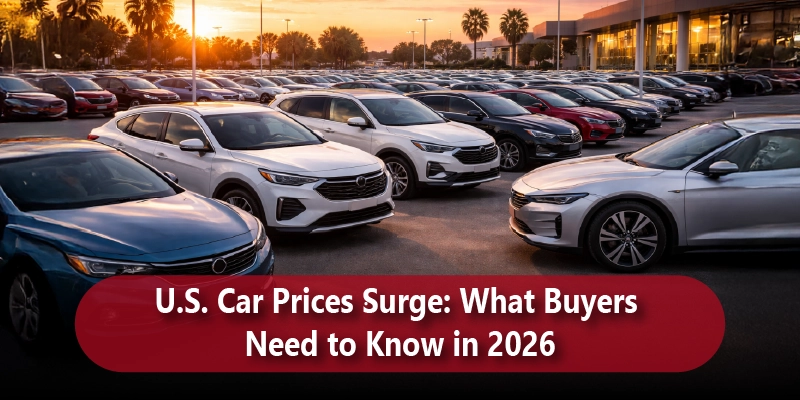
US car prices in 2026 remain high due to rising manufacturing costs, safety tech, inflation, and demand for SUVs, pushing average vehicle prices close to $50,000.

US Car Prices in 2026: Market Overview
Car buyers across the United States are still facing elevated vehicle prices in 2026. While supply chain disruptions that plagued the industry earlier in the decade have largely stabilized, the cost of purchasing a new vehicle remains significantly higher than pre-pandemic levels.
The average transaction price for a new car in the US now sits close to $50,000, reflecting a structural shift in the automotive market rather than a temporary spike.
Several long-term industry changes are shaping this new pricing environment. Automakers are investing heavily in advanced safety technologies, electrification, and software-driven features. At the same time, many manufacturers have reduced or eliminated entry-level models, focusing instead on higher-margin SUVs, crossovers, and trucks.
For many American households, affordability has become the central challenge. While high-income buyers continue to purchase premium vehicles, middle-income families are increasingly turning to the used car market or choosing smaller, value-focused models.
Understanding these evolving automotive market trends can help buyers make smarter decisions and avoid overspending in 2026.
Also Read: U.S. Auto Industry Outlook 2026: Sales Forecasts & Trends You Need to Know
Why Car Prices Are Rising in the US in 2026
Higher Technology and Safety Requirements
Modern vehicles include advanced driver-assistance systems, multiple cameras, radar sensors, and sophisticated software platforms. These technologies improve safety but also significantly increase manufacturing costs.
Federal safety regulations and fuel-efficiency standards have also pushed automakers to invest in lighter materials and new engineering solutions, adding further cost to production due to economic instability and geopolitical issues.
Shift Toward SUVs and Trucks
Consumer demand has shifted heavily toward SUVs, crossovers, and pickup trucks. These vehicles generate higher profit margins for manufacturers, which has led many brands to discontinue small, affordable sedans.
As a result, the number of vehicles priced below $20,000 has dropped sharply, raising the overall entry price for new cars.
Inflation and Supply Costs
Although supply chains have improved compared to earlier years, inflation continues to affect raw materials, transportation, and labor costs. Steel, aluminum, and semiconductor components remain more expensive than they were several years ago. These increases are now fully reflected in retail vehicle prices.
Interest Rates and Financing Costs
Increased interest rates are making car financing more costly for buyers. Many buyers are extending loan terms to 72 or even 84 months to maintain manageable monthly payments. While this reduces monthly costs, it often increases the total amount paid over the life of the loan.
Also Read: USA Auto Industry Outlook: How Detroit Is Shaping the Future
Key Automotive Market Trends in 2026
Despite higher prices, the automotive market in 2026 shows signs of stabilization.
Inventory Levels Are Improving
Dealership inventories are healthier than they were between 2022 and 2024. Buyers now have more options when it comes to trim levels, colors, and configurations.
Growth in the Used Car Market
A wave of vehicles leased during 2023 is now returning to dealerships. These off-lease vehicles are creating more choices for buyers looking for nearly new cars at lower prices.
Incentives Are Returning
Automakers are slowly reintroducing promotional offers such as:
- Cash rebates
- Low-interest financing deals
- Lease incentives
These offers can help offset the high sticker prices seen in the market today. Industry analysts suggest that the best deals in 2026 may come from low-APR financing promotions rather than major price reductions.
Affordable New Cars in the US for 2026
Even in a high-price market, several vehicles remain relatively affordable while offering strong reliability and value.
| Model | Estimated Starting Price | Key Advantage |
| 2026 Hyundai Venue | $22,150 | One of the most affordable crossovers available |
| 2026 Chevrolet Trax | $23,495 | Spacious interior and modern technology |
| 2026 Toyota Corolla | $24,120 | Excellent reliability and strong resale value |
| 2026 Kia K4 | $23,535 | Advanced technology and stylish design |
These vehicles provide practical alternatives for buyers who want a new car without entering the premium price bracket.
Also Read: Why Are Chinese Car Sales Falling, and What Does It Mean for U.S. Imports?
Smart Tips for Buying a Car in 2026
Focus on Total Cost Instead of Monthly Payments
Dealerships often emphasize monthly payments rather than the full vehicle cost. Always negotiate the final purchase price, including taxes and fees.
Compare Insurance Before Buying
Insurance costs have increased significantly in recent years. Checking insurance quotes before finalizing a purchase can help avoid unexpected expenses.
Consider Sedans for Better Value
Because SUVs dominate the market, demand for sedans has softened. This trend has created better deals in the sedan segment, where prices have slightly declined in some cases.
Look for Previous-Year Models
Dealers often offer significant discounts on leftover inventory when new model years arrive. A 2025 vehicle sold in 2026 may offer thousands in savings with minimal differences.
Frequently Asked Questions
Will US car prices drop in 2026?
Car prices are expected to stabilize rather than drop significantly, though incentives and financing deals may improve.
Why are used car prices still high?
Demand remains strong because fewer new vehicles are available at low price points.
Is 2026 a good year to buy an electric vehicle?
Yes. Used electric vehicle prices are falling due to higher supply and changing incentives.
What is the average car loan interest rate in 2026?
Buyers with excellent credit typically see rates between 5.5% and 7%, while subprime borrowers may face rates above 12%.
Are sedans cheaper than SUVs in 2026?
In many cases, yes. Lower demand for sedans has created more competitive pricing.
Key Takeaways
- The average new car price in the US is close to $50,000 in 2026.
- Advanced technology and safety systems are increasing vehicle production costs.
- SUVs and trucks dominate the market, reducing affordable entry-level options.
- Pre-owned vehicles and sedans provide more affordable options for buyers looking to stay within a limited budget.
- Financing deals and previous-year models may provide the best savings.
Get More Updated Automotive Insights at AskAboutcars!
For More Car-Related Blogs:
Have insights or experiences to share? Submit your blog through the link below and become part of our automotive community: https://askaboutcars.com/submit-blog/