
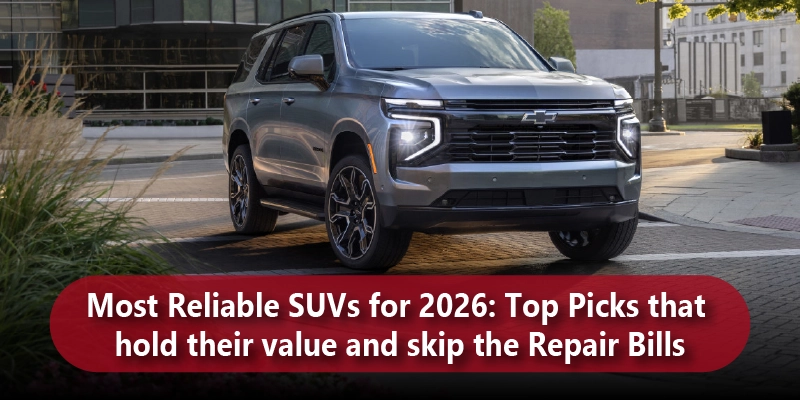
The most reliable SUVs in 2026 include Toyota 4Runner, Honda CR-V, and Lexus RX, offering durability, low maintenance, and strong resale value.
How Reliability Has Changed in 2026
Reliability in the automotive industry has undergone a significant transformation. A decade ago, it was largely defined by engine durability and transmission strength. In 2026, however, the concept has expanded to include software stability, cost-per-mile efficiency, and long-term ownership predictability.
Modern SUVs are no longer judged solely by how long they last mechanically, but by how consistently they perform across years of usage without introducing unexpected costs. Buyers today are increasingly aware that a vehicle’s true value lies not just in its purchase price, but in how it behaves over five to ten years of ownership.
Across global markets from dense urban environments to long highway commutes and mixed terrain conditions, three SUVs have consistently stood out for their dependability such as the Toyota 4Runner, Honda CR-V, and Lexus RX. These models represent a balance between proven engineering and modern efficiency, making them benchmarks in the 2026 reliability landscape.
Why the Toyota 4Runner Continues to Dominate Long-Term Reliability
The Toyota 4Runner remains one of the most respected names in long-lasting SUVs, and its continued dominance in 2026 is not accidental. While many manufacturers are aggressively shifting toward downsized turbocharged engines and highly complex systems, the 4Runner follows a more conservative and proven engineering path.
Its underlying philosophy is rooted in durability rather than experimentation. The vehicle retains a robust body-on-frame construction, which is inherently stronger for long-term use and better suited for demanding conditions. This structural advantage makes it particularly appealing to buyers who prioritize longevity over advanced features.
Another defining factor is its resale value. The 4Runner holds approximately 58 percent of its value after five years, placing it among the top-performing vehicles in depreciation metrics. This is not just a financial advantage and it is also a reflection of market trust in the vehicle’s reliability.
Maintenance is another area where the 4Runner excels. Its mechanical simplicity allows technicians to access components easily, reducing both labor time and service costs. In an era where repair bills are increasingly driven by electronic complexity, this simplicity becomes a major advantage.
Ultimately, the 4Runner continues to lead because it avoids unnecessary complexity and focuses on delivering consistent, predictable performance over time.
The Rise of Hybrid SUVs as Reliable and Low-Maintenance Options
Hybrid technology has matured significantly, and in 2026, it plays a central role in defining reliable SUVs. Vehicles like the Honda CR-V Hybrid and Toyota Grand Highlander Hybrid demonstrate how electrification can enhance long-term dependability rather than compromise it.
One of the primary reasons hybrids are gaining recognition for reliability is the way they distribute workload between the engine and the electric motor. During everyday driving, especially in stop-and-go traffic, the electric motor handles a significant portion of the demand. This reduces stress on the internal combustion engine, allowing it to operate under more controlled conditions.
Another important advantage lies in braking systems. Hybrid SUVs use regenerative braking, which converts kinetic energy into electrical energy. This reduces reliance on traditional friction brakes, resulting in slower wear of brake pads and rotors. Over time, this translates into fewer replacements and lower maintenance costs.
Additionally, modern hybrid systems eliminate several conventional mechanical components. Many no longer rely on belts for critical functions such as water pumps or air conditioning compressors. By reducing the number of moving parts, the likelihood of mechanical failure decreases.
The result is a driving experience that is not only more efficient but also more predictable in terms of maintenance. For many buyers, hybrid SUVs have become the ideal balance between innovation and reliability.
Top Reliable SUVs in 2026: Detailed Comparison
| Model | Category | 5-Year Resale Value | Reliability Profile | Ideal Usage |
| Toyota 4Runner | Midsize / Off-road | 58.0% | Mechanically robust and long-lasting | Tough terrain and long-term ownership |
| Honda CR-V Hybrid | Compact SUV | 53.2% | Efficient with reduced component wear | Urban and daily commuting |
| Lexus RX | Luxury Midsize | 51.5% | Premium build with stable technology | Comfort-focused buyers |
| Toyota Grand Highlander | Three-row SUV | 50.9% | Spacious and dependable | Family-oriented usage |
| Honda HR-V | Subcompact SUV | 50.4% | Practical and cost-efficient | Budget-conscious drivers |
This comparison highlights a clear pattern: vehicles that balance simplicity with refinement tend to perform best in long-term reliability.
What Defines a Reliable SUV in 2026
The modern definition of reliability goes beyond traditional mechanical durability. It now includes how well a vehicle integrates and manages its technology.
Software stability has emerged as a critical factor. Many recent reliability issues are no longer related to engines or transmissions but to infotainment systems, sensors, and driver-assistance features. Vehicles that maintain stable, user-friendly software environments are significantly less likely to require costly repairs.
Another defining factor is the complexity of the powertrain. SUVs that rely on proven configurations tend to have fewer issues over time compared to those that introduce entirely new and untested systems. This is one of the reasons brands like Toyota, Honda, and Lexus continue to perform consistently well in reliability rankings.
Maintenance predictability also plays a crucial role. A reliable SUV follows a consistent service pattern without unexpected breakdowns. This allows owners to plan expenses more effectively and avoid sudden financial strain.
Finally, the availability of parts and service support contributes to long-term reliability. Vehicles backed by strong global supply chains are easier and cheaper to maintain, particularly in markets where access to specialized components may be limited.
Why Resale Value Matters More Than Ever
Resale value is often overlooked, yet it is one of the most important indicators of a vehicle’s reliability. A car that retains a high percentage of its original value signals strong market confidence.
In 2026, resale value is closely tied to reliability metrics. Buyers are increasingly informed and tend to avoid models with known long-term issues. As a result, dependable SUVs maintain strong demand even after several years of use.
From a financial perspective, this translates into a lower total cost of ownership. A vehicle that depreciates slowly effectively reduces the overall expense of ownership, even if its initial purchase price is higher.
This is why models like the Toyota 4Runner and Honda CR-V continue to dominate and they deliver value not just during ownership, but also at the time of resale.
Common Mistakes That Affect SUV Reliability
One of the most common misconceptions among buyers is that reliability is purely mechanical. In reality, modern vehicles require equal attention to software updates. Ignoring system updates can lead to performance issues that may eventually require expensive fixes.
Another frequent mistake is choosing higher trims without considering long-term implications. While features such as air suspension and advanced seating systems enhance comfort, they also introduce additional points of failure.
Skipping routine maintenance is another critical issue. Even the most reliable SUVs depend on consistent servicing to maintain their performance. Neglecting basic maintenance tasks can significantly reduce a vehicle’s lifespan.
Finally, focusing only on the purchase price often leads to poor decisions. A cheaper vehicle with high depreciation and frequent repairs can ultimately cost more than a slightly more expensive but reliable alternative.
Best Reliable SUVs for Families in 2026
For families, reliability must be combined with practicality, comfort, and safety. SUVs like the Toyota Grand Highlander and Honda Pilot are particularly well-suited for this purpose.
These vehicles are designed to handle daily usage demands while maintaining consistent performance over time. Their widespread availability also ensures that parts and servicing remain affordable, which is a crucial consideration for long-term ownership.
The Lexus RX, while positioned as a luxury option, also offers exceptional reliability, making it a strong choice for families seeking both comfort and dependability.
Key Takeaways
- Reliability in 2026 goes beyond engine durability and includes software stability and overall ownership consistency.
- Toyota 4Runner, Honda CR-V, and Lexus RX lead due to proven engineering and long-term dependability.
- Hybrid SUVs offer lower maintenance needs by reducing engine stress and component wear.
- High resale value reflects strong reliability and reduces total cost of ownership.
- Simpler mechanical and electronic systems tend to perform better over time.
- Regular maintenance remains essential, even for the most reliable SUVs.
- Overloaded features and complex trims can increase long-term repair risks.
- Choosing a reliable SUV ensures predictable expenses and fewer unexpected breakdowns.
Frequently Asked Questions
Toyota 4Runner leads due to its durable construction and consistent performance.
Yes, modern hybrids reduce mechanical wear and improve efficiency.
Toyota 4Runner holds the highest resale value at around 58 percent.
Lexus RX proves that luxury and reliability can coexist effectively.
Regular servicing and timely maintenance are essential for long-term performance.
Get More Updated Automotive Insights at Ask About Cars!
Leave a Reply
You must be logged in to post a comment.