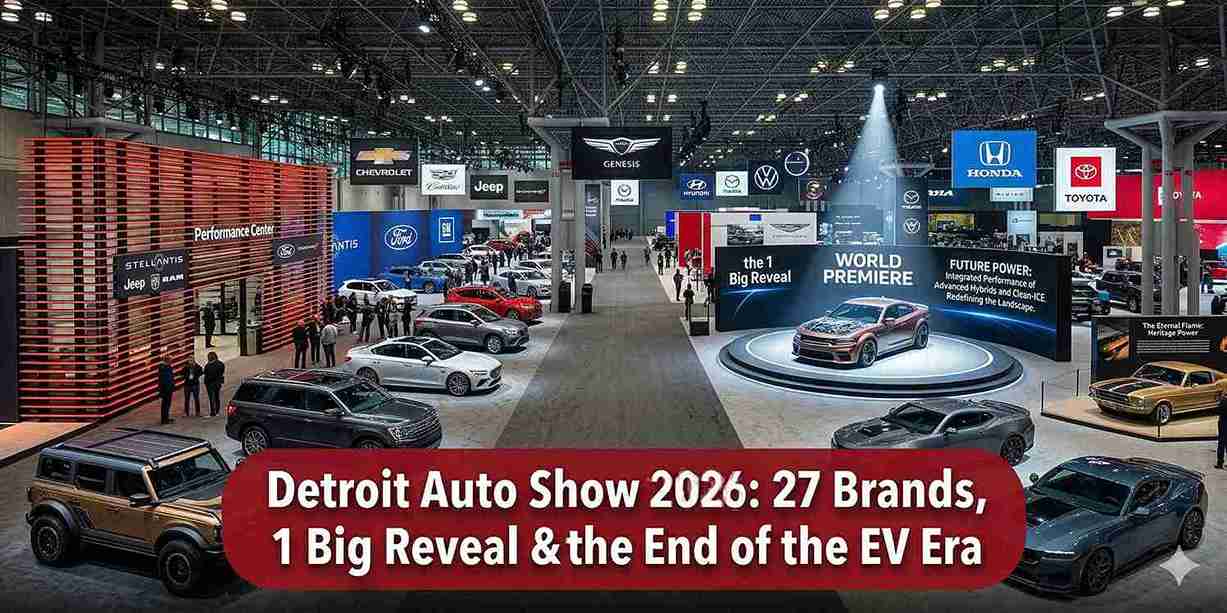
Detroit Auto Show 2026 highlights EV slowdown as hybrids and ICE regain focus, with fewer launches and rising demand for practical vehicles.
The Detroit Auto Show 2026, held from January 14-25 at Huntington Place, marked a clear turning point for the global automotive industry. Unlike previous years that emphasized aggressive electrification and concept-heavy showcases, this year’s event reflected a more grounded and strategic direction.
With 27 brands participating, the show was not short on presence, but it was notably restrained in terms of major launches. In fact, only one global reveal dominated the spotlight. This shift is not accidental. It reflects deeper changes in consumer demand, economic pressures, and long-term product planning.
Automakers are no longer racing to electrify at any cost. Instead, they are recalibrating their strategies to balance innovation with practicality, profitability, and infrastructure realities. The result is a noticeable shift toward hybrid technology and refined internal combustion engine vehicles.
This blog breaks down what really happened at the Detroit Auto Show 2026, why it matters, and what it means for car buyers and the future of mobility.
A Shift from Hype to Practical Execution
One of the most noticeable aspects of the Detroit Auto Show 2026 was the reduced emphasis on big reveals. While earlier editions were filled with concept cars and ambitious EV announcements, this year focused more on production-ready vehicles and incremental updates.
Most automakers chose to showcase:
- Updated versions of existing models
- Hybrid variants of popular vehicles
- Performance-oriented ICE models
- Technology upgrades rather than entirely new platforms
This reflects a broader industry trend where companies are prioritizing execution over experimentation. Instead of unveiling vehicles that may take years to reach production, brands are focusing on products that can be sold immediately.
Another major factor is the shift toward digital-first launches. Many manufacturers now prefer to unveil their flagship models through controlled online events, where they can manage messaging, timing, and audience engagement more effectively. As a result, traditional auto shows are evolving into platforms for validation rather than revelation.
The Only Major Reveal: 2027 Ford Bronco RTR
The defining highlight of the Detroit Auto Show 2026 was the unveiling of the 2027 Ford Bronco RTR, a vehicle that stood out not just because of its capabilities but because it was the only true global debut in an otherwise restrained event. In a year where most automakers chose to showcase updates rather than innovations, the Bronco RTR became the focal point of attention for both enthusiasts and industry analysts.
Built in collaboration with RTR Vehicles, a brand known for high-performance builds, the Bronco RTR is designed specifically for serious off-road users and lifestyle-driven buyers. It represents a segment that continues to show strong demand and vehicles that prioritize experience, durability, and real-world capability over purely technological advancements.
Unlike many modern launches that focus heavily on software and electrification, the Bronco RTR brings the spotlight back to mechanical performance and terrain dominance. It is engineered to handle extreme conditions, from rocky trails to desert landscapes, reinforcing Ford’s commitment to the off-road segment.
Key Highlights
- Enhanced Off-Road Performance:
Upgraded suspension systems, improved ground clearance, and specialized off-road tires make it capable of tackling challenging terrains with confidence. - Aggressive and Functional Design:
The exterior design is not just about aesthetics, and it serves a purpose. Wider stances, reinforced body elements, and aerodynamic adjustments contribute to both performance and durability. - Built for Real-World Use:
Unlike concept-heavy showcases, the Bronco RTR emphasizes practicality. It is designed for actual usage rather than being a theoretical or future product. - Refined ICE Powertrain:
Retaining an internal combustion engine, the vehicle integrates modern engineering improvements to deliver better efficiency, performance, and reliability without compromising its core identity. - Lifestyle and Customization Appeal:
The Bronco RTR is not just a vehicle; it’s a platform. Buyers in this segment often seek personalization, and this model supports that culture with aftermarket compatibility and modular upgrades.
Why This Reveal Matters
The significance of the Bronco RTR goes beyond being the only major launch. It reflects a broader market reality, and not all segments are moving toward electrification at the same pace.
Off-road and performance-oriented vehicles continue to rely heavily on ICE platforms due to:
- The need for consistent power delivery in extreme conditions
- Limited charging infrastructure in remote areas
- Consumer preference for reliability and ease of refueling
This reveal also highlights an important psychological factor in automotive demand. While EVs appeal to efficiency and sustainability, vehicles like the Bronco RTR appeal to emotion, identity, and adventure factors that remain powerful drivers of purchase decisions.
At the 2026 Detroit Auto Show, the Bronco RTR serves as a reminder that the automotive industry is not abandoning innovation but diversifying its approach. Electrification will continue to grow, but vehicles that deliver raw capability and experiential value will remain a strong presence in the market.
Understanding the EV Slowdown
The Detroit Auto Show 2026 reinforced a growing reality: the electric vehicle market is not declining, but it is no longer expanding at the rapid pace seen in previous years.
Several key factors are contributing to this slowdown:
High Initial Costs
Electric vehicles continue to carry higher upfront costs compared to hybrids and ICE vehicles. While operating costs may be lower, the initial price remains a barrier for many buyers.
Reduction in Incentives
Government subsidies and tax credits played a major role in boosting EV adoption. However, many of these incentives have been reduced, phased out, or made more restrictive, making EVs less financially attractive.
Charging Infrastructure Challenges
Charging infrastructure is still unevenly distributed. This creates challenges for:
- Apartment residents without dedicated parking
- Rural and semi-urban users
- Long-distance drivers
The lack of consistent and convenient charging options continues to influence buyer decisions.
Consumer Hesitation
Many buyers are adopting a wait-and-watch approach. Concerns around battery life, resale value, and long-term reliability are leading consumers to delay EV purchases.
The Rise of Hybrids as a Practical Solution
As EV growth stabilizes, hybrids are emerging as the most balanced and practical option in the current market.
Hybrids combine the benefits of electric driving with the reliability of traditional engines. This dual approach addresses many of the concerns associated with full electrification.
Why Hybrids Are Gaining Popularity
- Lower upfront cost compared to EVs
- No dependency on charging infrastructure
- Improved fuel efficiency
- Reduced emissions compared to ICE vehicles
- Familiar driving experience
Automakers are increasingly investing in hybrid technology because it aligns well with current market conditions. It allows them to meet regulatory requirements while still appealing to a broad customer base.
For consumers, hybrids offer a low-risk entry point into electrification without requiring major lifestyle adjustments.
Key Highlights and Award Winners
The awards and highlights from the Detroit Auto Show 2026 reflect the industry’s shift toward practicality and versatility.
Major Winners
- Dodge Charger – North American Car of the Year
- Ford Maverick Lobo – Truck of the Year
- Hyundai Palisade (Hybrid) – Utility Vehicle of the Year
What These Winners Represent
The Dodge Charger’s recognition highlights the importance of flexibility, as it offers multiple powertrain options. The Ford Maverick Lobo demonstrates the growing demand for compact, efficient trucks that balance utility and affordability. The Hyundai Palisade Hybrid showcases the increasing importance of family-oriented vehicles with improved efficiency.
These winners share a common theme: they are designed for real-world use rather than niche innovation.
Changing Consumer Preferences in 2026
Consumer behavior in the automotive market is evolving rapidly, shaped by economic conditions, rising ownership costs, and changing mobility needs. Buyers today are far more informed and cautious than in previous years, making decisions based on long-term value rather than short-term excitement. The shift is clear, and practicality is now taking precedence over experimentation.
Key Trends
Increased focus on total cost of ownership
Buyers are no longer evaluating vehicles based solely on the purchase price. Instead, they are considering the complete financial picture, including fuel or charging costs, maintenance expenses, insurance premiums, and resale value. This holistic approach is driving more balanced and financially sound decisions.
Preference for reliability over cutting-edge technology
While advanced features and digital interfaces remain attractive, consumers are prioritizing proven reliability. Vehicles that offer consistent performance, lower maintenance risks, and dependable engineering are gaining more trust than those loaded with untested or complex technologies.
Growing interest in fuel efficiency
With fluctuating fuel prices and increasing awareness of running costs, efficiency has become a major deciding factor. Buyers are actively seeking vehicles that deliver better mileage, whether through hybrid systems or optimized internal combustion engines.
Demand for versatile, multi-purpose vehicles
Modern consumers prefer vehicles that can adapt to multiple use cases, such as daily commuting, family travel, and occasional long-distance trips. This has increased the demand for SUVs, crossovers, and compact trucks that offer flexibility, space, and comfort without compromising efficiency.
Common Buyer Mistakes to Avoid
As the market shifts, many buyers are still making decisions based on outdated assumptions.
Waiting for Future EV Models
Many anticipated EV launches have been delayed. Waiting indefinitely can lead to missed opportunities, especially when current options are already competitive.
Ignoring Resale Value
EV depreciation trends are still stabilizing. Buyers should carefully consider long-term value retention when making a purchase.
Overestimating Incentives
Tax benefits are no longer as generous as before. Buyers should calculate the actual cost rather than relying on expected savings.
Prioritizing Features Over Usability
Advanced features are appealing, but practicality and ease of use are more important for daily driving.
| Category | Electric Vehicles (EVs) | Hybrids | ICE Vehicles |
| Initial Cost | High | Moderate | Low to Moderate |
| Running Cost | Low | Low to Moderate | High |
| Infrastructure Need | High (charging required) | None | None |
| Range Flexibility | Moderate | High | Very High |
| Resale Stability | Evolving | Stable | Stable |
| Best Use Case | Urban commuting | Daily mixed usage | Long-distance & performance use |
What This Means for the Future
The Detroit Auto Show 2026 does not signal the end of electric vehicles. Instead, it marks a transition toward a more balanced and realistic approach.
Short-Term Outlook (2026-2028)
Hybrids are expected to dominate as the preferred choice for most consumers.
Mid-Term Outlook (2028-2032)
Improved battery technology and expanded infrastructure will likely drive renewed EV growth.
Long-Term Outlook
The industry will move toward electrification, but with a diversified mix of powertrains rather than a single dominant solution.
Automakers are adapting to real-world conditions rather than pushing aggressive timelines. This approach is more sustainable and better aligned with consumer needs.
Frequently Asked Questions
- What was the biggest reveal at the Detroit Auto Show 2026?
The 2027 Ford Bronco RTR was the only major global debut.
2. Why is the EV market slowing down in 2026?
High costs, reduced incentives, and charging limitations impacted demand.
3. Are hybrids better than EVs right now?
Hybrids are more practical for most users in current conditions.
4. Which vehicles won major awards?
Dodge Charger, Ford Maverick Lobo, and Hyundai Palisade Hybrid.
5. Is it a good time to buy a car in 2026?
Yes, especially with strong hybrid options and available discounts.
6. Will EV demand increase again?
Yes, as infrastructure and affordability improve over time.
Key Takeaways
- The Detroit Auto Show 2026 focused on practicality rather than innovation hype
Unlike previous years that were dominated by concept vehicles and ambitious electrification announcements, the 2026 show emphasized real-world readiness. - EV growth has slowed, but remains part of the long-term future
The pace of electric vehicle adoption has stabilized due to factors such as high upfront costs, reduced incentives, and infrastructure limitations. However, this slowdown does not signal a decline in EV relevance. Instead, it reflects a transitional phase where the market is recalibrating. - Hybrids are emerging as the most balanced solution
Hybrid vehicles have positioned themselves as the most practical option in the current landscape. They offer a middle ground by combining fuel efficiency with the convenience of traditional refueling. - Consumer preferences are shifting toward reliability and cost efficiency
Today’s car buyers are making more calculated decisions, prioritizing total cost of ownership over cutting-edge features. Reliability, fuel efficiency, maintenance costs, and resale value are now key decision-making factors. - Automakers are prioritizing sustainable and scalable strategies
Manufacturers are adopting a more disciplined approach to product development and investment. Instead of rapidly expanding EV lineups without guaranteed demand, they are focusing on scalable solutions that ensure profitability and operational stability.
Get More Updated Automotive Updates at Ask About Cars!
For advertising, sponsored content, or brand collaboration opportunities on this platform, please visit: https://askaboutcars.com/advertise/
Leave a Reply
You must be logged in to post a comment.